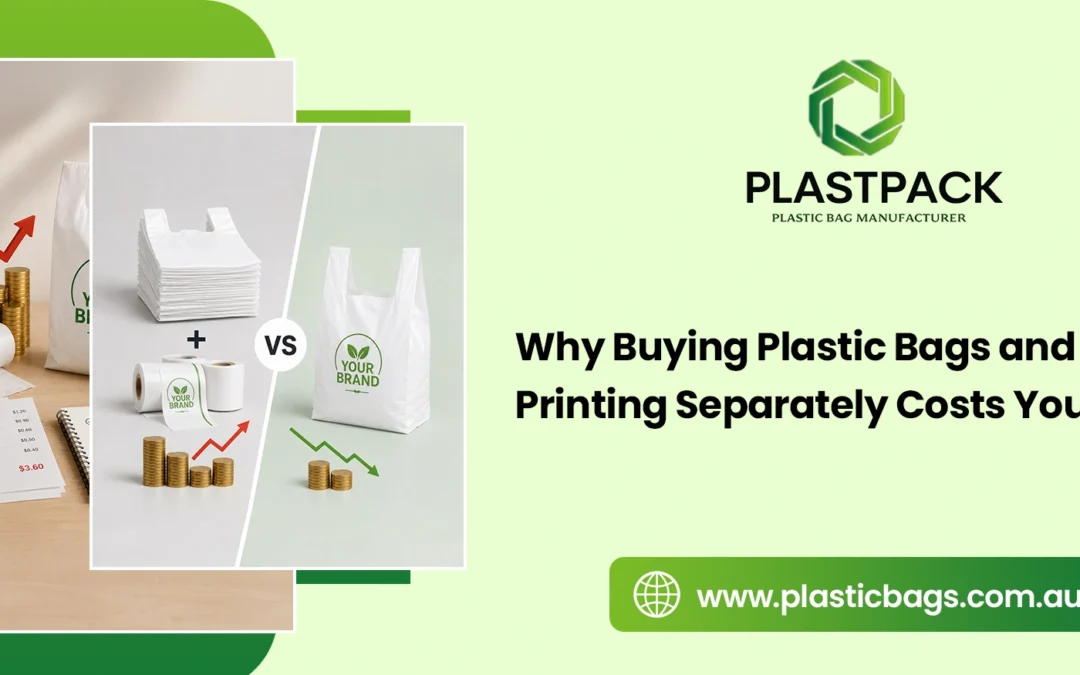
Buying plain plastic bags from one supplier and sending them to a separate printer can look like the cheaper route on a quote. In day to day operation it rarely is. Every handover between a blank bag supplier and an outside print house adds margin, freight, handling and waiting time, and it limits what the print can do on a bag that has already been formed. When you buy custom printed bags from a single manufacturer that extrudes its own film, prints it and forms the bags in one facility, those handovers disappear. For procurement teams and operations managers weighing up their next order, that difference decides the real landed cost.
The hidden cost of the two supplier model
The split approach usually works like this. You order plain poly or carry bags from a wholesaler, then arrange a separate print run somewhere else. Two things get missed on the spreadsheet. The first is that two businesses each apply their own margin and their own minimum charge, so you pay twice for coordination that a single supplier folds into one price. The second is handling. Blank stock has to be received, checked, repacked and freighted to the printer, then received and freighted again to you. Each leg carries a cost and a risk of damage before the bags have done any work at all.
Minimum order quantities are the other quiet expense. A bag supplier and a print house set their minimums independently, and they seldom line up. You either over order blank bags to satisfy the printer, or split a run and lose the volume rate. A manufacturer that prints in house sets one minimum against one job, so the quantity you order is the quantity you actually need.
Why lead times stack up when printing is separate
Lead time is where the split model hurts most. Run the clock through it. The blank bags have to be produced or picked, then dispatched to the printer, then queued behind the printer’s other jobs, then printed, then sent on to you. Every step waits on the one before it, and any delay at a single point pushes the whole delivery back. Businesses that have been caught short on packaging know how quickly that timeline blows out.
A vertically integrated manufacturer starts from a different position. Plastpack (formerly Churchill & Coombes) holds roughly 50 tonnes of film stock on site, which means the raw material for most standard and custom orders is already in the building. Printing and bag forming happen in the same workflow rather than in two separate queues at two separate companies. The result is a single production schedule that Plastpack controls from film to finished carton, and short, predictable turnaround for the buyer.
Printing after the bag is formed limits the result
There is a quality reason to keep printing and manufacturing together, not only a cost one. In an integrated operation the artwork is printed onto the flat film web before the bag is formed. That allows clean, consistent registration, edge to edge coverage and up to six colour printing across the surface. When a separate print house works on bags that are already made, the print is constrained by the formed shape, the seams and any handles, which restricts placement and repeatability across a run.
This is the difference between a printed bag that reflects your brand accurately on every unit and one that drifts from bag to bag. If you want the technical detail on how artwork is applied to film during production, the printing on film note walks through the process.
What changes when one manufacturer controls the whole run
Plastpack operates as a vertically integrated manufacturer at its Werrington, New South Wales facility, with film extrusion, printing, bag forming, quality control and dispatch under one roof. The business has supplied the Australian market since 1928, and it remains the manufacturer rather than a reseller of imported stock. For a buyer, that structure changes three practical things.
Specification is the first. Because the film is made in house, bags can be produced to a set size, gauge, seal type and colour rather than forced to fit a fixed catalogue item. If you are unsure which specification suits the job, the thickness guide and the bottom seal versus side seal notes cover the common decisions. Accountability is the second. One supplier owns the finished result, so any variation between runs can be traced and resolved without pointing between two companies. Supply reliability is the third, backed by the film stock held on site and a delivery service that reaches businesses Australia wide.
Where custom printing pays for itself
Printed packaging earns its place when the bag is already part of your workflow. A printed carry bag handed across a retail counter, a printed courier bag moving through the delivery chain, a printed press seal bag used for sample dispatch, or a printed poly bag in a food packing line all carry your brand at no extra step in the operation. You are buying the bag regardless. Printing it converts a running cost into visibility. The full range sits on the custom printed bags page.
This is also why buying plastic bags in bulk and printing them as one job makes commercial sense for high volume users. Ordering blank and branded stock through the same manufacturer keeps the unit rate down while removing the second supplier entirely. The wholesale buying guide sets out how volume orders are handled.
How to brief a printed bag order so you do not overspend
A clean brief keeps a print run efficient. Supply your artwork with the colours confirmed, up to six, and set the bag specification alongside it: size, gauge, seal type and quantity. Ask for a sample of the base bag before the run is locked in, so the film and format are approved before printing begins. Confirm the artwork placement in writing. Handling those points up front removes the back and forth that adds days to a job. The ordering guide covers what to send and how the process runs, and Plastpack’s team can assist with artwork and sizing during the order.
If you are pricing your next packaging order, add up the full path the split model takes before you compare it against a single supplier. Two margins, two freight legs, two minimums and a stacked lead time usually cost more than the line on the quote suggests. To get a specification and printed sample sorted, send your requirements through the contact page.
Frequently Asked Questions
Is it cheaper to buy plastic bags and print them separately?
It usually is not, once you count the full path. A blank bag supplier and a separate printer each add margin, freight and a minimum charge, and the two lead times stack up. Buying custom printed bags from one manufacturer removes the second supplier and the double handling.
Why does buying printed bags from one manufacturer reduce lead time?
Because printing and bag forming run in the same workflow instead of two separate queues at two companies. With around 50 tonnes of film held on site, the raw material for most orders is already available, so production can begin without waiting on a blank bag delivery first.
Can any plastic bag be custom printed?
Custom printing is available on poly bags, carry bags, courier bags and press seal bags. Because the film is printed before the bag is formed, the print is consistent across the run, with up to six colours and edge to edge coverage.
How many print colours can I put on a plastic bag?
Up to six colours are available, applied to the film in house during production. Confirming your colours and artwork up front keeps the run efficient and avoids added setup time.
Do I need a large minimum order to get bags printed?
Minimums apply to a print run, but ordering blank and printed stock through the same manufacturer means one minimum against one job rather than two that rarely line up. You can request a sample of the base bag before committing to the full run.