
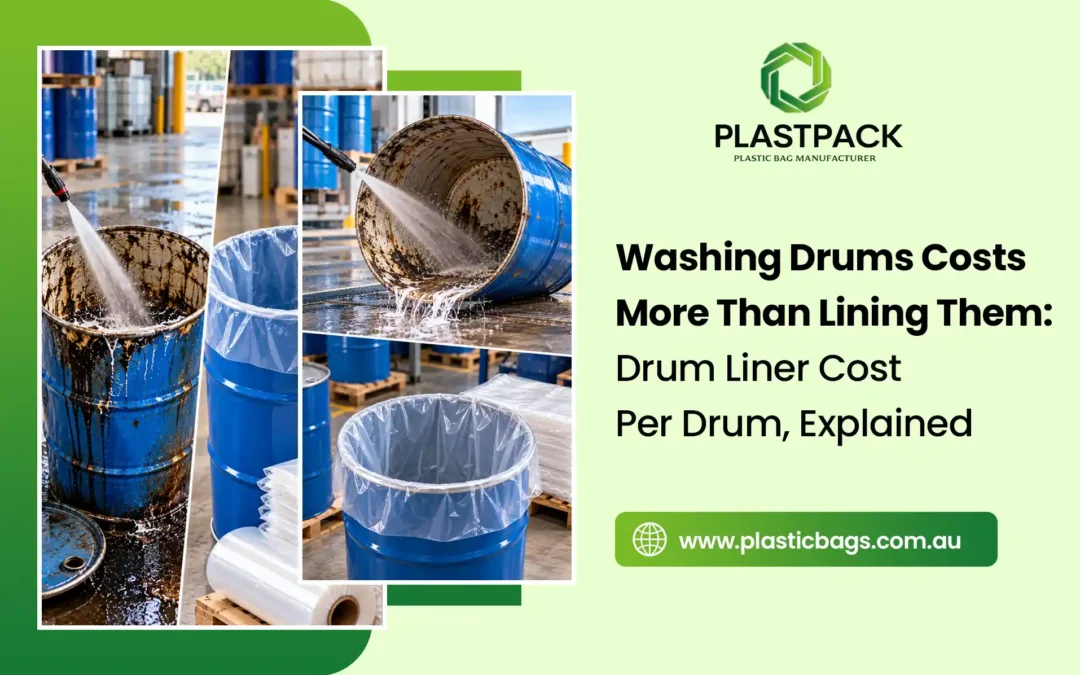
Most businesses that reuse drums ask the wrong question. They ask what a drum liner costs, compare it to the price of a wash, and decide washing is free because the water is already connected and the staff are already on site. Neither is true. The water is metered, the labour is paid, and the real question is not what a liner costs. It is what washing a drum actually costs you every time you do it.
This article breaks down the genuine cost per drum of lining versus washing, so operations and procurement teams can see where the money really goes. Plastpack (formerly Churchill & Coombes) has manufactured plastic bags in Sydney since 1928 and extrudes its own film, so the detail here comes from making the product and supplying the industries that use it.
What are drum liners?
Drum liners are heavy-duty polyethylene bags sized to line the inside of a drum. You drop the liner in, fill the drum, and when it is emptied you remove and discard the liner, leaving a clean drum ready to refill straight away. One liner is used per fill.
They are standard across food processing, pharmaceutical manufacturing and chemical operations, where a clean, uncontaminated drum surface is not optional. Plastpack’s drum liners are made to resist heavy loads and prevent leaks, and they stop one batch from ever touching the residue of the last.
The real cost of washing a drum
Washing looks cheap because its costs are spread across accounts that nobody adds up against the drum. Line them up and the picture changes:
Water. Cleaning a drum properly uses a serious volume of water, and water is metered and charged. Every drum, every cycle.
Detergents and sanitisers. Cleaning chemicals are a consumable spent on each wash, and food or pharmaceutical work needs validated agents, not just any detergent.
Labour. Someone has to wash, rinse, dry and inspect each drum. That is paid time that produces nothing, repeated for every drum in the cycle.
Downtime. A drum being washed and dried is a drum out of service. To keep running you either hold more drums than you need or you wait, and both cost money.
Wastewater disposal. Washwater carrying food, chemical or pharmaceutical residue often cannot go down a normal drain. Trade-waste charges, on-site treatment or licensed disposal all attach to it, along with the compliance paperwork.
Contamination risk. This is the big one. A washed drum is never guaranteed clean. Residue from the last fill can carry into the next, and the cost of a single cross-contaminated or failed batch dwarfs anything you spent on cleaning.
Drum wear. Repeated washing, especially with hot water and chemicals, degrades the drum over time, shortening its life and bringing forward the cost of replacing it.
Add those together per drum, per cycle, and washing stops looking free. It is a recurring variable cost with a large hidden tail of risk sitting behind it.
What a drum liner costs you instead
A drum liner replaces all of that with a single, known, per-fill cost. You line the drum, use it once, and discard the liner. There is no wash, no washwater, no drying, no downtime, and the drum goes straight back into service. Every fill starts on a clean, unused surface, so cross-contamination between batches is designed out rather than hoped for. Contents also lift and pour out more cleanly, so less product is left clinging to the drum.
So the honest way to read cost per drum is not the liner price on its own. It is the small, predictable cost of a liner set against the larger, variable cost of washing plus the risk of a ruined batch. For most operations running repeat fills, the liner wins on both.
What the liner itself costs depends on a few things: the drum size, the film gauge, whether a food-grade specification is needed, and the quantity you order. Tell us those and we will quote it. The per-unit cost drops as volume rises, which is why most buyers order by the sleeve.
240 litre drum liners: sizes and gauges
The standard drum liner suits a 240 litre drum. Plastpack’s 240 litre drum liners measure 1000mm wide by 1500mm long and come in four standard gauges, packed 100 per sleeve:
The 50 micron liner suits lighter, straightforward contents and short-term lining where the main job is keeping the drum clean, such as dry goods lining and batch separation. The 75 micron liner steps up for heavier and wetter fills and more handling. The 100 micron liner carries heavier and denser loads with better tear and puncture resistance, which makes it the usual pick for industrial dust extractors and swarf bins. The 150 micron liner is the extra heavy-duty option for the most demanding contents, sharp offcuts, dense sludge and longer storage.
For context, most bin and drum liners sold in Australia top out at 30 to 40 micron, so even the lightest 50 micron grade sits above the general market. The right gauge comes down to the weight and nature of what goes in the drum and how long it sits there. If you are unsure, tell us the contents and we will match the gauge.
Food processing and industrial drum liners
Drum liners do different jobs in different plants. In food processing and pharmaceutical work, the value is batch separation and cross-contamination control: a fresh liner between runs removes the residue risk of reusing a drum without a full wash. Where the liner is in direct contact with food, a food-grade film can be specified, so confirm a food-grade requirement when you order. For lining cartons and bulk bins on a food line, our food-grade carton liners are the purpose-made product.
For chemical, waste and general industrial use, the priority shifts to wall strength and leak resistance, which is where the heavier gauges earn their place alongside the rest of our industrial bags range. Tell us the application and we will specify the right film and gauge for it rather than leaving you to guess.
Buying drum liners in bulk
Drum liners are a per-fill consumable, so a steady bulk supply at a sensible per-unit cost is what keeps the lining-over-washing case strong. We supply drum liners by the sleeve of 100 across Australia, direct from the manufacturer, and because we hold around 50 tonnes of film on site, the material for most orders is already here, which keeps lead times short. Because we extrude the film and form the liners in house, the micron on the box is the micron in the bag, carton after carton, and for regular buyers we can hold your size and gauge on file for fast reorders.
When a 240 litre liner is not the right fit, we make drum liners to a custom size, gauge, colour and print, with minimum run quantities on custom work, and they sit naturally alongside related warehouse consumables such as pallet top sheets and caps. If you are setting up a regular supply, our guide on buying plastic bags wholesale covers how to lock it in.
To work out the right drum liner and set up supply, contact the Plastpack team with your drum size, contents, gauge and quantity, and we will sort it.
Frequently Asked Questions
How much does a drum liner cost per drum?
A liner is a small, known per-fill cost, and the figure depends on the drum size, film gauge, whether a food-grade specification is needed, and the quantity ordered. The more useful comparison is against what washing the same drum costs each cycle. Send us your spec for a quote.
Are drum liners cheaper than washing drums?
In most repeat-fill operations, yes, once you count the full cost of washing: water, cleaning chemicals, labour, downtime, wastewater disposal and the risk of a contaminated batch. A liner replaces all of that with one per-fill cost and a clean surface every time.
What size are 240 litre drum liners?
Plastpack’s 240 litre drum liners measure 1000mm wide by 1500mm long and fit standard 240 litre drums. They come in 50, 75, 100 and 150 micron gauges, packed 100 per sleeve.
Can drum liners be used in food processing?
Yes. A fresh liner between batches controls cross-contamination without washing the drum between runs, which is why food, pharmaceutical and chemical processors use them for batch separation. For direct food contact, confirm a food-grade film specification when you order.
Can I buy drum liners in bulk or in custom sizes?
Yes. We supply drum liners by the sleeve of 100 across Australia and, as the manufacturer, produce custom sizes, gauges, colours and print to order, with film held on site to keep lead times short.