If you work in warehousing, logistics, food manufacturing, agriculture, or any industry where goods are stacked and moved on pallets, you have almost certainly come across a pallet cover. They are one of those everyday industrial products that quietly do an important job without drawing much attention to themselves. But when goods arrive damaged, wet, or contaminated, the absence of a proper pallet cover becomes very obvious very quickly.
This guide covers what pallet covers are, how they work, what they are made from, and how to choose the right one for your operation. Whether you are new to pallet protection or looking to improve the way your business handles goods in storage and transit, understanding pallet covers properly will save you time, product losses, and unnecessary costs.
At Plastpack, we have been manufacturing industrial packaging products for Australian businesses since 1928. Pallet bags and pallet covers are a key part of our industrial range, and we supply them to customers across manufacturing, distribution, food processing, cold storage, agriculture, and more.
What is a Pallet Cover?
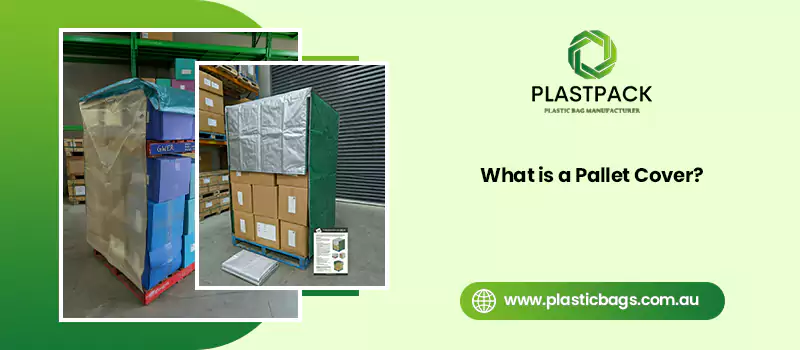
A pallet cover is a large, oversized plastic bag or sheet designed to encase a loaded pallet and protect its contents from external elements during storage, transit, or both. The cover slips over or around the stacked goods on a pallet and acts as a physical barrier against dust, moisture, rain, condensation, insects, contamination, and general handling damage.
Pallet covers are also referred to as pallet bags, pallet hoods, or pallet top sheets depending on their specific design and application. While the terms are sometimes used interchangeably, they each describe slightly different product types, which we will explain further below.
The core purpose of a pallet cover is simple: to keep goods in the condition they were in when they left your facility, right up until they arrive at their destination or are retrieved from storage. For businesses that move or store products of any kind, this is a practical necessity rather than a luxury.
Why Pallet Protection Matters
Before looking at the different types of pallet covers, it is worth understanding why protecting pallets properly is so important in the first place.
Protection from Moisture and Contamination
Moisture is one of the most common causes of goods damage in transit and storage. Whether it is rain during outdoor loading and unloading, condensation forming on cold goods in a warm environment, or humidity in an open warehouse, moisture finds its way into unprotected goods with predictable regularity. A well-fitted pallet cover creates a waterproof barrier that keeps contents dry regardless of what happens around them.
Dust, dirt, and airborne contamination are equally problematic in many environments. In food processing and pharmaceutical facilities, contamination is not just a quality issue but a regulatory one. In dusty warehouses or outdoor storage areas, unprotected goods accumulate grime that creates problems downstream.
Protection During Transit
Goods on pallets are handled multiple times between origin and destination. They are moved by forklifts, loaded onto trucks, unloaded at distribution centres, and transferred again before reaching their final point. Every one of those transitions is an opportunity for something to go wrong. A pallet cover does not prevent every accident, but it provides a meaningful layer of protection against incidental contact, light impact, and environmental exposure throughout the journey.
Compliance and Food Safety
In the food and pharmaceutical industries, protecting goods from contamination is not optional. Regulatory requirements govern how food products must be stored and transported, and a properly covered pallet is part of meeting those requirements. Food-grade pallet covers, which are manufactured from approved materials and are clearly identifiable, are used specifically in these environments to ensure compliance and peace of mind.
Presentation and Professionalism
A cleanly covered pallet also says something about the business behind it. Goods arriving at a customer’s facility neatly covered in a clean, undamaged pallet bag create a better impression than goods arriving dusty, damp, or exposed. In competitive markets, attention to detail in packaging and presentation can reinforce a supplier’s reputation for care and quality.
Types of Pallet Covers
Not all pallet covers are the same. There are several distinct product formats, and choosing the right one for your application depends on how your pallets are loaded, where they will be stored or transported, and what level of protection you need.
Pallet Bags (Bag Style)
A pallet bag is a large, open-topped bag made from polyethylene film. The bag slips over the entire loaded pallet from the top down, encasing the goods on all four sides and the top. The open end sits at the bottom near the pallet base, where it can be tucked under or left open depending on the application.
Pallet bags are one of the most widely used pallet protection formats in Australian industry. They are quick to apply, provide all-around coverage, and are available in a range of sizes and thicknesses to suit different pallet loads. At Plastpack, our pallet bags are supplied on rolls for easy dispensing, which speeds up application in busy warehouse and production environments.
The roll format is a significant practical advantage. Rather than handling individual bags stacked flat, a worker can pull the required bag from the roll, tear or cut it off, and apply it to the pallet in a single continuous motion. This reduces the time spent on pallet covering and makes the process easier to manage in high-throughput settings.
Pallet Top Sheets (Pallet Caps)
A pallet top sheet, sometimes called a pallet cap, is a flat sheet of polyethylene film that is placed on top of a loaded pallet rather than slipped over the entire load. It protects the top of the pallet from falling debris, dust, and light moisture without enclosing the sides.
Top sheets are commonly used in combination with stretch wrap. The stretch wrap goes around the sides of the pallet to stabilise the load and provide side protection, while the top sheet covers the upper surface. This combination offers good all-round coverage and is particularly useful when the stretch wrap does not extend far enough over the top of the load to provide reliable moisture protection.
Pallet top sheets are a cost-effective option when full bag coverage is not required or when the goods are already well protected on the sides. Plastpack stocks pallet top sheets as part of our industrial product range, available in a range of dimensions to suit standard pallet configurations.
Gusseted Pallet Bags
Gusseted pallet bags have folded side panels built into the film, which allow the bag to expand outward when applied to a pallet. This design accommodates loads that are wider or less uniform in shape than a standard square pallet. The gusset panels fold flat when the bag is stored on a roll but open out when the bag is placed over a loaded pallet, providing a closer and more even fit around the sides of the load.
For businesses handling a variety of pallet sizes or irregularly shaped loads, gusseted bags offer more flexibility than flat pallet bags without requiring multiple different bag sizes.
Food Grade Pallet Bags
Food-grade pallet bags are manufactured from polyethylene that has been specifically approved for contact with food products. They are used to line pallet bins, protect food ingredients during storage, or cover finished food products during transit. In most cases, food-grade bags are blue in colour, which makes them easily distinguishable from general-purpose bags and reduces the risk of confusion in food-handling environments.
At Plastpack, our blue pallet bags are food-grade and suitable for internally lining pallet bins in food processing and distribution settings. The blue colouring also makes them more visible if a fragment were ever to be present in a product, which is an important consideration for food safety management systems.
What Are Pallet Covers Made From?
The vast majority of pallet covers sold in Australia are made from Low-Density Polyethylene (LDPE) or Linear Low-Density Polyethylene (LLDPE). These materials offer an excellent balance of strength, flexibility, and moisture resistance, which makes them well suited to the demands of industrial use.
LDPE Film
LDPE is soft, flexible, and stretchy, with good transparency and strong moisture resistance. It performs well across a wide temperature range, which makes it suitable for both ambient storage and cold chain applications. LDPE pallet bags conform reasonably well to the shape of a loaded pallet and are resistant to tearing under normal handling conditions.
LLDPE Film
LLDPE is a modified form of polyethylene with improved tensile strength and puncture resistance compared to standard LDPE. It is commonly used for heavier-duty pallet bags where the load is heavier, sharper, or where the bag will be subjected to more handling. LLDPE film can be made thinner than LDPE while maintaining comparable strength, which can offer material savings at high volumes.
Film Thickness
Pallet bag thickness is measured in microns (µm). At Plastpack, our pallet bags are available in a range of thicknesses from 40µm through to 100µm, covering everything from lighter food-grade applications through to heavy industrial use. As a general guide:
40µm bags are suitable for lighter loads and food-grade applications where the primary requirement is contamination protection rather than heavy-duty mechanical strength.
50µm bags offer a good general-purpose option for standard warehouse and distribution use.
75µm bags provide increased puncture and tear resistance for heavier or more demanding applications.
100µm bags are heavy-duty and best suited to industrial environments, heavy loads, rough handling conditions, or where the bags will be exposed to sharp edges or abrasive surfaces.
Choosing the right thickness for your application reduces waste from bag failures while avoiding unnecessary expenditure on over-specified bags.
Standard Pallet Sizes in Australia
Understanding standard Australian pallet dimensions helps when selecting the right size pallet bag. The most common pallet size used in Australia is the standard CHEP or plain timber pallet, which measures 1165mm x 1165mm. This is frequently referred to as a 1.2 metre pallet, and most standard pallet bags are designed around this footprint.
When selecting a pallet bag, you need to account for the width and depth of the pallet base plus the height of the loaded goods. A bag that fits the pallet width but is too short to cover a tall load will not provide adequate protection. Plastpack’s pallet bag range includes lengths from 1850mm to 2500mm, accommodating loads of varying heights on standard Australian pallets.
If your pallets are non-standard in size, or if you consistently handle very tall or wide loads, custom-sized pallet bags can be manufactured to your exact specifications. Our team is available to help you work out the right dimensions for your particular application.
Industries That Use Pallet Covers
Pallet covers are used across virtually every sector that moves goods on pallets, but some industries rely on them more heavily than others.
Food and Beverage Manufacturing
Food manufacturers use pallet covers at multiple points in their operations, from covering raw ingredient pallets in storage to protecting finished goods during transit to retail distribution centres. Food-grade blue bags are the standard specification in this sector, providing a visible and compliant means of protecting product from contamination.
Cold Chain and Refrigerated Logistics
In cold storage and refrigerated transport, condensation is a persistent challenge. When a cold pallet is moved into a warmer loading dock or delivery environment, moisture from the air condenses on the surface of the goods. A pallet cover provides a protective layer that keeps this condensation on the outside of the bag rather than soaking into the product packaging. This is particularly important for paper-based packaging that can weaken or become illegible when wet.
Agriculture and Horticulture
Pallets of produce, seeds, fertilisers, and agricultural inputs are regularly stored outdoors or in partially open sheds where they are exposed to rain, dust, and insects. Pallet covers provide a straightforward and cost-effective means of protecting these goods from the elements during outdoor storage and transport.
Pharmaceuticals and Healthcare
In pharmaceutical and healthcare supply chains, maintaining product integrity and hygiene from manufacture through to dispensing is critical. Pallet covers are part of the protective packaging regime that helps ensure products arrive at hospitals, pharmacies, and healthcare facilities in the condition they left the manufacturer.
Manufacturing and Industrial Distribution
Manufacturers shipping components, finished goods, or raw materials on pallets use pallet covers to protect product from dust, moisture, and handling damage across their distribution networks. In heavy industrial environments where goods are stored in open warehouses or near dusty production processes, pallet covers provide day-to-day protection for stock waiting to be processed or shipped.
Retail Distribution
Retailers and their distribution centre operators use pallet covers to protect goods as they move through the supply chain from supplier to store. In retail environments, presentation matters, and goods arriving in clean, covered pallets reflect positively on both the supplier and the retailer’s supply chain management.
How to Apply a Pallet Bag Correctly
Applying a pallet bag properly takes only a short time, but doing it correctly makes a meaningful difference to how well the bag performs. Here are the key steps:
Start with a fully loaded and stable pallet. A pallet bag applied to an unstable or poorly stacked load may not sit evenly and could shift or tear during transit.
Pull the bag from the roll to the required length and cut or tear it free. Having the roll mounted on a dispenser near the packing area makes this faster and reduces the chance of the bag being dragged across the floor and picking up contamination.
Open the bag by shaking it out or blowing air into the opening. Slide the bag over the top of the pallet load, pulling it down evenly on all sides until the bottom of the bag reaches or clears the base of the pallet.
Straighten any wrinkles or folds in the bag to ensure even coverage on all sides. If the bag has a gusset, make sure the side panels have opened fully and are lying flat against the sides of the load.
If the pallet is to be stretch-wrapped as well, apply the stretch wrap over the pallet bag. The stretch wrap will hold the bag in place and add additional load stability. The pallet top sheet, if used, should be placed on top of the load before the bag is pulled down, so the sheet is tucked inside the bag and protected from above.
Pallet Covers and Stretch Wrap: Understanding the Difference
A question that comes up regularly is how pallet covers relate to stretch wrap, and whether you need both. They are different products that serve different purposes, and in many operations, they work best when used together.
Stretch wrap is an elastic plastic film that is wound tightly around a loaded pallet under tension. It holds the load together, prevents items from shifting or falling during transit, and provides some side protection against dust and moisture. However, stretch wrap alone does not provide reliable protection against rain or heavy condensation, particularly on the top of the load.
A pallet bag or top sheet complements the stretch wrap by providing full enclosure or top coverage. Together, they create a load that is both stable and well protected from the elements. For loads that will be stored outdoors, transported over long distances, or handled in environments with significant dust or moisture exposure, using both is the more reliable approach.
Choosing the Right Pallet Cover for Your Operation
With several types and specifications available, here is a simple framework for choosing the right pallet cover:
If your pallets are standard 1.2 metre square and your loads are of typical height, a standard clear pallet bag on a roll in 50µm or 75µm will suit most general warehousing and distribution requirements.
If you are handling food products or goods that will come into contact with food, specify a blue food-grade bag to satisfy compliance requirements and make contamination risk visible.
If your loads are heavy, sharp-edged, or subjected to rough handling, specify 100µm bags for the additional puncture and tear resistance they provide.
If your primary concern is top-surface protection rather than full enclosure, a pallet top sheet used in combination with stretch wrap is a practical and cost-effective option.
If your pallet sizes are non-standard or your loads are unusually tall, speak with the Plastpack team about custom sizing to ensure the bags fit your specific pallet configuration properly.
Why Source Pallet Covers from Plastpack?
Plastpack has been manufacturing plastic bags and film in Australia since 1928. Our pallet bags are manufactured in-house at our Australian facility using premium-grade polyethylene film, with in-house extrusion and bag-forming giving us direct control over film consistency, thickness tolerance, and seam integrity.
We hold approximately 50 tonnes of film stock at our factory at any given time, which means we can manufacture and dispatch orders quickly without the long lead times that come with importing stock. Our pallet bags are supplied on rolls for easy dispensing in warehouse and production environments, and we stock a range of thicknesses and dimensions to cover most standard applications.
For customers with specific requirements, we can also manufacture pallet bags to custom dimensions and thicknesses, printed bags are available for branding purposes, and food-grade blue bags are stocked specifically for food contact applications.
To discuss your pallet cover requirements or to request a quote, contact the Plastpack team at sales@plasticbags.com.au or call 02 9649 6111. You can view our full range of pallet bags and related products at plasticbags.com.au.
Frequently Asked Questions
What is the difference between a pallet bag and a pallet top sheet?
A pallet bag is a large open-ended bag that slips over the entire loaded pallet to enclose it on all four sides and the top, providing full coverage against moisture, dust, and contamination. A pallet top sheet is a flat sheet of film placed only on the top surface of the pallet, typically used in combination with stretch wrap to protect the upper portion of the load. Which one you need depends on your application, and in many operations, both are used together for comprehensive pallet protection.
What thickness pallet bag do I need for general warehouse use?
For most standard warehouse and distribution applications involving typical packaged goods, a 50µm pallet bag provides reliable protection at a reasonable cost. If your loads are heavier, include sharp-edged items, or will be handled in rougher conditions such as outdoor sites or heavy industrial environments, stepping up to a 75µm or 100µm bag will give you noticeably better puncture and tear resistance and reduce the chance of bag failures.
Are Plastpack pallet bags suitable for food contact applications?
Yes. Our blue pallet bags are manufactured from food-grade polyethylene and are specifically designed for use in food contact environments, including internally lining pallet bins. The blue colouring makes them easily distinguishable from general-purpose bags in food handling areas, which helps with compliance and contamination risk management. If you are unsure which bag specification is right for your food application, our team can advise you.
Can I get pallet bags in custom sizes if my pallets are non-standard?
Yes. While we stock pallet bags in standard sizes suited to the common 1.2 metre Australian pallet footprint, we can manufacture pallet bags to custom dimensions for non-standard pallet sizes or unusually tall load heights. Contact us at sales@plasticbags.com.au or call 02 9649 6111 to discuss your specific requirements and our team will work out the right specification for you.
What is the benefit of pallet bags supplied on a roll rather than flat-packed?
Pallet bags on a roll are significantly faster and easier to apply in a busy warehouse or production environment. Workers can pull the required length from the dispenser, cut the bag free, and apply it to the pallet in one smooth process, rather than searching through a stack of flat-folded bags. The roll format also takes up less floor space, keeps bags cleaner and more organised, and reduces the time spent on pallet covering during busy dispatch periods.