
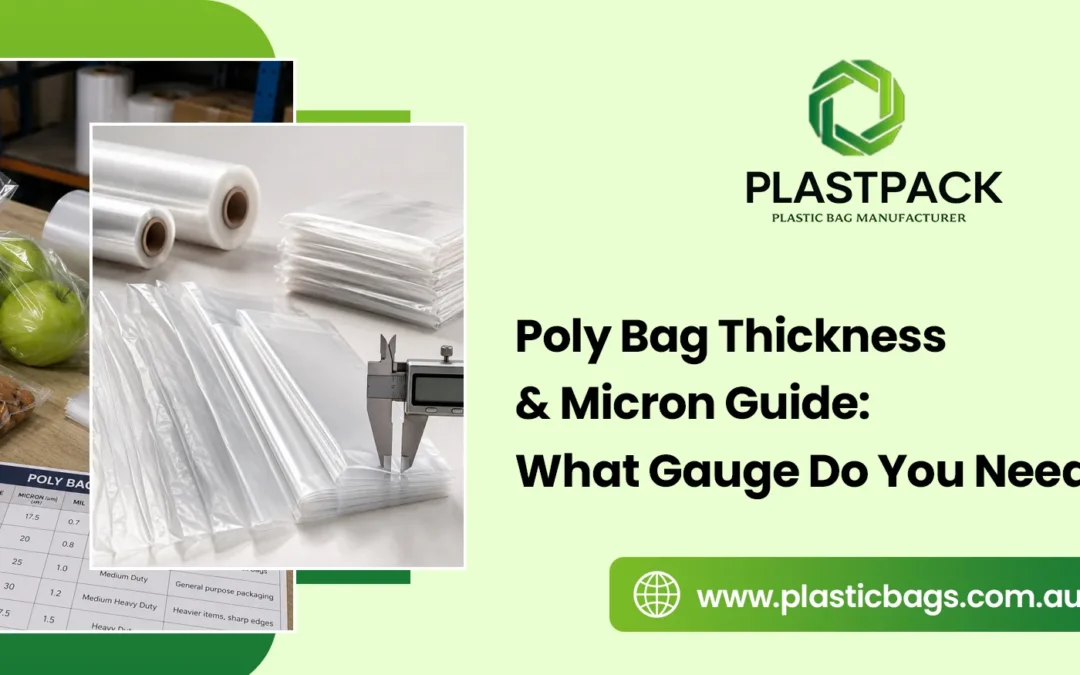
Getting poly bag thickness right is one of those decisions that seems minor until a bag fails. Order too thin and product splits through, spills happen and complaints follow. Order too thick and you are carrying material the job never needs, and the bag is stiffer to handle and seal. The goal is the correct gauge for the load, not the heaviest one on the shelf.
In Australia, poly bag thickness is measured in microns. Light goods such as garments and produce suit around 25 to 35 microns, general packing sits around 40 to 50 microns, and heavy or sharp items need 75 to 100 microns or more. The right number depends on the load, how it is handled, and how the bag is sealed.
This guide explains what a micron is, how it compares to gauge and mil, and how to match the thickness to your application, with the resin and seal details most guides leave out.
What is a micron?
A micron, written µm, is one-thousandth of a millimetre. When a poly bag is described as 50µm, that figure is the thickness of the plastic film itself, not the size of the bag. Thicker film resists tearing and puncturing under heavier or sharper loads, which is why gauge is chosen around the contents rather than the bag dimensions.
A useful reference point: a 50µm bag is roughly 40% thicker than a 35µm bag of the same size, so it holds up noticeably better under stress. In Australia, poly bags are almost always specified in microns, so quoting everything in µm keeps comparisons clean.
Micron, gauge and mil: how the units compare
You will occasionally see other units, usually on imported or older listings. They all measure the same thing, film thickness, in different ways. Comparing everything in microns avoids mix-ups.
| Unit | What it is | Rough equivalent |
| Micron (µm) | One-thousandth of a millimetre; the Australian standard | 25 µm is about 100 gauge |
| Gauge | A US and UK convention seen on imported listings | 100 gauge is about 25 µm |
| Mil | One-thousandth of an inch | 1 mil equals 25.4 µm |
If a spec sheet mixes units, convert it all to microns before you compare. A bag quoted at “200 gauge” is around 50µm, and a “2 mil” bag is around 50µm as well, so they are broadly comparable even though the numbers look nothing alike.
Why poly bag thickness matter?
Thickness sets the strength, puncture resistance and overall performance of the bag. Get it wrong on the thin side and you end up double-bagging, which uses more material than a single correctly gauged bag would have. Get it wrong on the thick side and you pay in handling and sealing difficulty, and in material that the application never calls on.
Thickness also affects how a bag behaves on the line. Heavier film is stiffer to open and fill, and it needs more heat and pressure to seal. Choosing the correct gauge from the start keeps your packing process smooth and your product protected.
What gauge do you need? Poly bag thickness by application
The table below is a practical starting point for common commercial uses. Treat these as ranges, not fixed rules, because the load weight, edges, handling and transport conditions all shift the ideal thickness.
| Application | Suggested micron range |
| Light garments, soft goods, produce | 25 to 35 µm |
| General product bagging, light mailing | 35 to 50 µm |
| Heavier retail, component and food packing | 50 to 75 µm |
| Heavy or sharp items, carton liners, industrial parts | 75 to 100 µm |
| Bulky, abrasive or heavy-duty use (waste, builders film, pallet) | 100 µm and above |
A few practical notes sit alongside that table. Freezer and cold-store use tends to want the heavier end of a range, because film takes more of a beating over long cold stints. Sharp or angular contents push you up a band regardless of weight, since a puncture starts a tear. And resealable packs such as press seal bags are chosen partly on wall thickness, where a firmer wall gives a more secure seal and better product visibility. For custom-sized jobs, layflat poly tubing lets you pick a gauge and cut the length to suit the product.
Thickness is only part of the story: resin and seal
Two bags at the same micron can perform very differently depending on what they are made from. Low-density polyethylene (LDPE) is soft and flexible, high-density polyethylene (HDPE) is stiffer and stronger for its weight, and linear low-density polyethylene (LLDPE) adds puncture and tear resistance. Because an LLDPE or blended film can deliver the same real-world strength at a lower gauge, choosing the right resin sometimes lets you reduce thickness without losing performance, which cuts material use. This is where thickness and material choice work together rather than in isolation. If you are weighing up materials, our guides on plain poly bags and the full plastic bags range show what each film is built for.
Seal type matters too. Bottom-seal bags are formed from a single extrusion with a sealed base, which runs cleanly on automated heat-sealing equipment, while side-seal bags are made from tubing for general packing. Whichever you use, remember that heavier film needs more heat, pressure or dwell time to seal properly. If you run automated lines, set the machine for the gauge you are actually using, because a temperature suited to 40µm will not form a reliable seal on 100µm film.
Nominal versus full gauge: the detail resellers rarely mention
Here is something most buying guides skip, and it can catch you out. Film is often produced to a nominal gauge, which means the finished thickness can run slightly under the stated figure, commonly by up to around 10%, unless full gauge is specified. A bag listed as 50µm nominal may measure a little less in practice.
For many applications, that tolerance is fine. For jobs where exact thickness matters, whether for consistent machine performance, a regulated requirement or a demanding load, you can specify full gauge so the film is produced to the stated thickness. Knowing the difference lets you ask the right question when you order, and it is one of the clearest signs of buying from a manufacturer rather than a reseller stocking whatever a third party produced.
How to choose the right gauge
Work through it in order. Start with the contents: their weight, their edges and whether anything sharp could start a puncture. Add the handling and transport the bag will face, since a satchel moving through a parcel network needs more than a bag lifted once off a shelf. Factor in temperature, because cold and freezer use want the heavier end of a range. Then confirm how the bag will be sealed, so the gauge suits your equipment. When two options look close, request samples and test them against a real load before committing to a run.
For higher-volume and multi-size ordering, matching gauge to each product line pays off across the whole operation. Our wholesale plastic bags guide walks through matching specification to order size, and courier bags are a good example of a product where gauge, seal and durability are chosen together for the parcel network.
Why buy poly bags from a manufacturer
Most suppliers hold whatever thickness a third party produces, which limits your options to standard stock. Plastpack works differently. We extrude our own film and form bags in-house at our Australian facility, with a heritage in the trade dating back to 1928, so we can produce the exact micron your application needs, to nominal or full gauge, in the resin and seal that suit the job. If you are unsure which thickness to specify, our team can recommend a gauge, advise where a better resin lets you downgauge safely, and provide samples to test before you order. Browse the plastic bags range or ask us to quote a made-to-spec run.
Frequently asked questions
What is a micron in poly bags?
A micron (µm) is one-thousandth of a millimetre, and it measures the thickness of the plastic film, not the size of the bag. In Australia, poly bags are almost always specified in microns.
How do I convert microns to gauge?
Gauge is a US and UK unit you see on imported listings. As a rough guide, 100 gauge is about 25 microns, and 1 mil equals 25.4 microns. Comparing everything in microns avoids mix-ups.
What micron poly bag do I need?
It depends on the load. Light goods such as garments and produce suit 25 to 35µm, general packing suits 40 to 50µm, and heavy or sharp items need 75 to 100µm or more. Match the gauge to the job rather than defaulting to the thickest.
Is a thicker poly bag always better?
No. Over-specifying wastes film and makes the bag stiffer to handle and seal, while the right gauge protects the product without excess. The aim is the correct thickness for the load, not the heaviest available.
Does thickness affect heat sealing?
Yes. Thicker film needs more heat, pressure or dwell time to seal properly. If you run automated sealing lines, set the equipment for the gauge you are using to avoid weak seals.