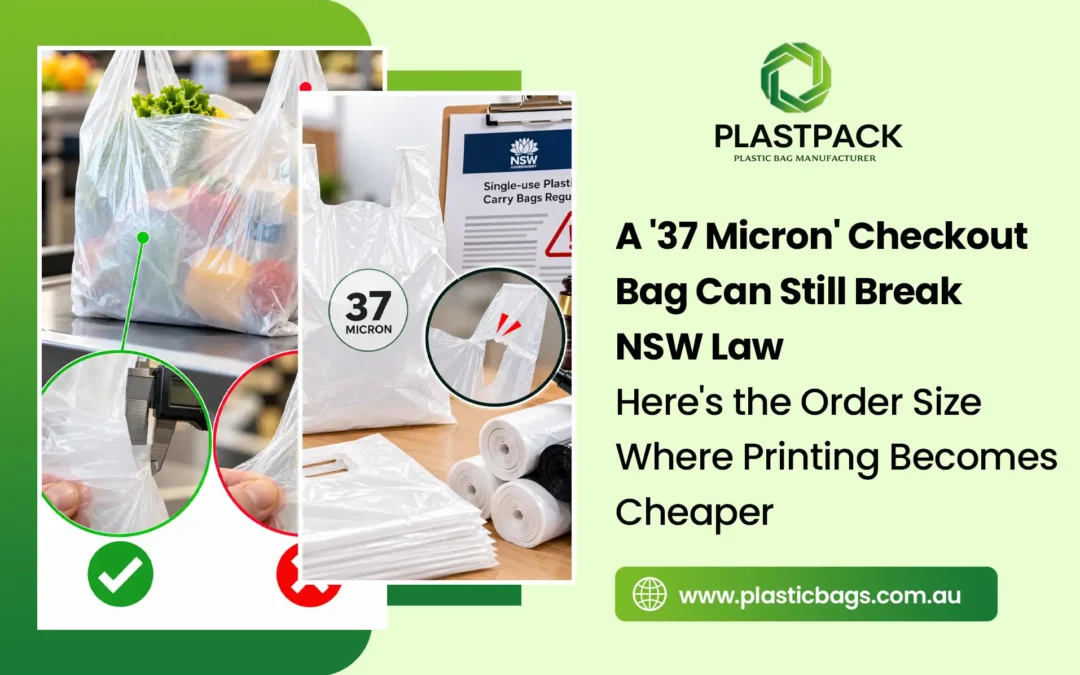
A supplier tells you the checkout bags are 37 microns, safely over the 35 micron line, so you order a pallet. Months later you learn they were still illegal. It sounds unfair, but it comes down to five words in the legislation that most buyers never read: “at any part of the bag.” The NSW ban does not measure the average thickness of a bag. It measures the thinnest point. And a bag that averages 37 microns can easily dip below the limit somewhere, which is all it takes.
This article explains what the NSW plastic bag ban actually says, how the “any part of the bag” rule works, and what it means for anyone supplying checkout bags in NSW. It is general information to help you ask the right questions, not legal advice. For the current rules and your specific situation, check the NSW Environment Protection Authority (EPA) guidance at epa.nsw.gov.au.
What the NSW plastic bag ban actually says
Lightweight plastic shopping bags were banned across NSW from 1 June 2022 under the Plastic Reduction and Circular Economy Act 2021. The NSW EPA is the regulator and enforces the ban.
The legislation defines a banned lightweight plastic bag as a bag with handles, made fully or partly of plastic, that is 35 microns or less in thickness at any part of the bag. Read that definition carefully, because every part of it does work. It has to have handles. It has to be plastic, in whole or in part. And the thickness test is not an average or a nominal figure, it is the measurement at any part.
The “any part of the bag” rule explained
This is the detail that catches businesses out. To sit outside the lightweight-bag ban, a plastic bag with handles has to be more than 35 microns thick at every single point. If any part of it is 35 microns or less, it is a banned lightweight bag, full stop.
That matters because a bag is not one uniform thickness. Plastic film is manufactured to a target gauge with a tolerance either side, so a bag quoted at 37 microns may actually run a few microns thinner in places. On top of that, gussets, seams and folded sections are often thinner than the main panel. So a bag sold to you as 37 microns can measure 34 or 35 microns at a gusset or a thin spot, and at that point it is illegal to supply in NSW, no matter what the label or the invoice says.
The lesson is simple. A nominal micron figure is not the same as compliance. What counts under the law is the thinnest part of the bag, and that is the number you need to be sure about.
Which bags are banned, and which are not
The ban targets lightweight plastic shopping bags with handles. It does not apply to everything made of plastic film. Bags that are generally not caught include barrier bags such as bin liners, nappy bags, dog waste bags, produce and deli bags, and bags used to contain medical waste, because they do not have handles and serve a different function. Bags that form an integral part of the packaging that seals goods for sale are also treated differently.
Heavier reusable bags are the other side of the line. A genuine heavyweight reusable plastic bag, one that is comfortably over 35 microns at every part, with handles, and built to be used many times, is not a lightweight plastic bag and so is not banned by this rule. The key word is genuinely over the threshold everywhere, not nominally close to it.
“Compostable” and “biodegradable” do not make a bag legal
This is the second trap. The NSW ban specifically includes lightweight bags made from biodegradable plastics, compostable plastics and bio-plastics, including those made from Australian certified compostable plastic. A label that says “plant-based”, “compostable”, “biodegradable” or “degradable” does not exempt a bag from the ban. If it is a lightweight plastic bag with handles at or under 35 microns at any part, it is banned whether it is conventional plastic or a compostable alternative.
So swapping a thin conventional bag for a thin compostable one does not solve the problem. The thickness and handle rules apply the same way.
The fines for getting it wrong
The ban is on supply, not use. A customer cannot be fined for using a banned bag. The business that supplies it carries the obligation, and the penalties are real. Maximum court penalties run to $55,000 for a corporation and $11,000 for an individual. For manufacturers, producers, wholesalers and distributors, those maximums are doubled, to $110,000 for a corporation and $22,000 for an individual, and failing to comply with a stop or compliance notice can carry higher penalties again. The EPA can also issue on-the-spot penalty notices and publishes a public register of compliance notices, penalty notices and convictions.
It is also an offence to provide false or misleading information about the supply of a banned item, which is worth remembering when a supplier assures you a bag is “ban compliant” without the evidence to back it.
How to make sure your checkout bags are compliant
A few practical points follow from all of the above.
First, do not rely on a nominal micron figure. Ask for the thickness at the thinnest part of the bag, including gussets and seams, and make sure it sits clearly above 35 microns with margin, not right on the line.
Second, know that no one can “certify” a bag as legal for you. The NSW EPA does not endorse, approve or certify any specific product, so a supplier’s “ban compliant” sticker is a claim, not a guarantee. The responsibility for what you supply sits with you.
Third, buy from a source that controls and can confirm the film thickness. A manufacturer that extrudes its own film controls the gauge on the line, so the micron on the specification is the micron in the bag, rather than a nominal figure from a reseller passing on whatever a third party produced. If you need a thickness guide to frame the conversation, our note on what thickness you need is a useful starting point, and our explainer on biodegradable bags covers why a compostable label is not a free pass under the ban.
Finally, remember that plastic is only one option. Paper, cardboard, cloth, jute and non-woven reusable bags are all outside the plastic bag rule, and a genuine heavyweight reusable bag is the compliant plastic choice where you want one.
Getting compliant checkout bags
As a Sydney plastic bag manufacturer, we make reusable carry bags and singlet and checkout bags, and because we extrude and control our own film we can specify and confirm the thickness at every part rather than quote a nominal figure. If checkout bags are part of your operation, tell us your requirement and we will help you specify a bag with genuine margin over the threshold, and you should confirm the final spec against the current NSW rules before you commit.
The rules are also still evolving, with the NSW EPA consulting on further plastic phase-outs, so treat this as a point-in-time explainer and check the NSW EPA for the current position before ordering.
Frequently Asked Questions
Are plastic bags banned in NSW?
Lightweight plastic shopping bags with handles that are 35 microns or less at any part of the bag have been banned since 1 June 2022 under the Plastic Reduction and Circular Economy Act 2021. Heavier reusable bags above the threshold, and barrier bags like bin liners and produce bags, are not caught by this rule.
How thick do plastic bags need to be to be legal in NSW?
A plastic bag with handles must be more than 35 microns thick at every part. The law measures the thinnest point, not the average, so a bag with a nominal 37 microns can still be banned if any part of it, such as a gusset or seam, measures 35 microns or less.
Does the NSW ban include compostable or biodegradable bags?
Yes. The ban applies to lightweight bags made from biodegradable, compostable and bio-plastics, including Australian certified compostable plastic. A “compostable” or “plant-based” label does not make a thin, handled plastic bag legal to supply.
What are the fines for supplying banned plastic bags in NSW?
Maximum court penalties reach $55,000 for a corporation and $11,000 for an individual, doubled to $110,000 and $22,000 for manufacturers, wholesalers and distributors. The NSW EPA enforces the ban, can issue penalty notices and publishes a public register of actions.
How do I know if my checkout bags are compliant?
The NSW EPA does not certify any product, so confirm the bag is above 35 microns at every part, ask for the thickness at its thinnest point, and buy from a maker who controls the film gauge. Check the current rules with the NSW EPA, as the responsibility for what you supply sits with your business.