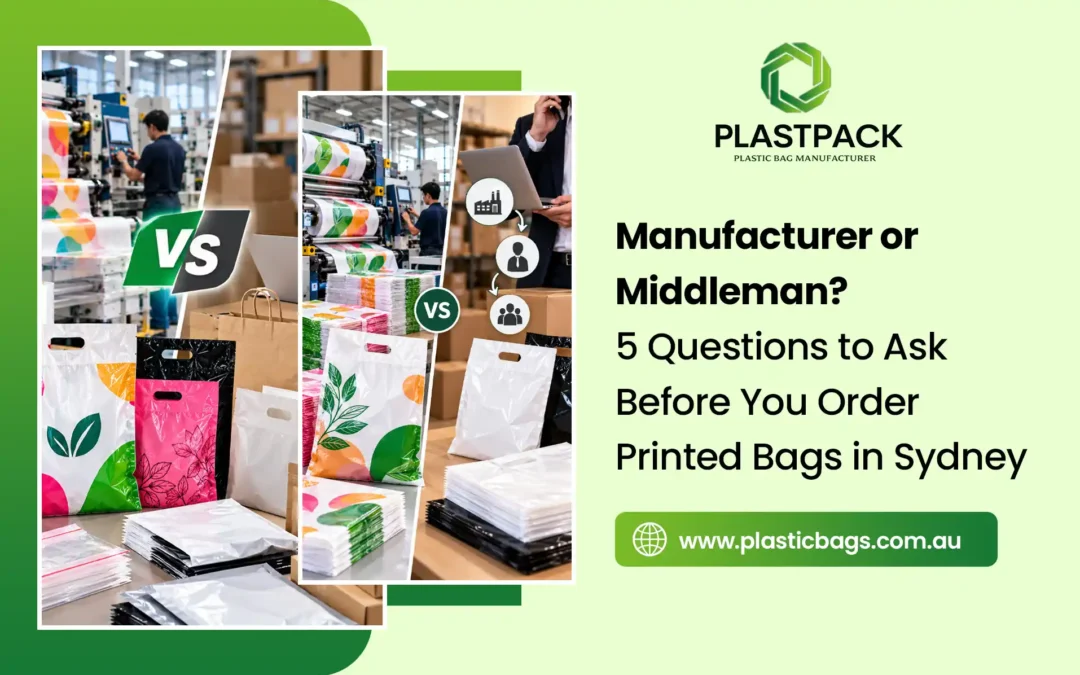
Most websites selling printed bags call themselves a supplier, a manufacturer, or both, and the label tells you almost nothing. A large share of businesses selling plastic bags in Australia do not make them. They buy bags from a factory, often overseas, warehouse them, and sell them on. That is a perfectly normal way to run a business, but it changes what you can expect on lead time, consistency, custom work and who is accountable when something goes wrong.
The good news is you do not need insider knowledge to work out who you are dealing with. Five straight questions will tell you. Plastpack (formerly Churchill & Coombes) has manufactured plastic bags in Sydney since 1928, so we have been on the receiving end of these questions many times, and here is what good answers look like.
Why it matters who actually makes your bags
When the business you order from is also the business that makes the bags, four things sit within their control: the specification, the film quality, the production schedule and the fix if a batch is wrong. When there is a middleman in between, all four depend on someone else’s factory and someone else’s timetable. That is why the same printed bag order can be smooth from one supplier and a running problem from another. The questions below are designed to surface that difference before you commit.
Question 1: Do you make the bags, or buy and resell them?
This is the question everything else hangs on. Ask it directly. A manufacturer extrudes its own film and forms the bags on its own lines. A middleman buys finished or blank bags from a factory and resells them, with their margin built into the price.
A good answer is specific and verifiable: we extrude our film and form the bags at our factory. A vague answer that talks around production, or leans on phrases like “we work with trusted partners,” usually means the bags are made somewhere else. Neither is wrong, but you should know which one you are buying before you build a brand around their product.
Question 2: Where are the bags and the printing actually done?
Ask where the factory is, and ask separately where the printing happens, because they are often two different places. Printed bags that are made offshore carry weeks of sea freight and customs on top of production, and printed bags that are bought blank locally then sent to a separate printer wait in two queues and move between two businesses.
A real manufacturer can name its factory and tell you the printing happens there too. We manufacture and print at our Sydney facility, with the film, the printing and the bag forming under one roof, which is the opposite of a job that bounces between a supplier and an outside printer. If a supplier cannot tell you where the bags are made, that is an answer in itself.
Question 3: What are your real lead times, and what happens when I reorder?
Every supplier quotes a lead time. The useful follow-up is what drives it, and what happens when you run short. A middleman’s lead time is at the mercy of their supplier’s schedule and, for imported stock, the next shipment. If they run out between shipments, so do you.
A manufacturer that holds film stock controls its own timeline. We hold around 50 tonnes of film on site, so for most jobs the material is already here, and for regular customers we can hold your spec and artwork on file so reorders move quickly. Ask the supplier directly: if I need a repeat run in a hurry, is that your decision to make or your supplier’s. The answer tells you who is really in control.
Question 4: Can you make it exactly to my spec?
A middleman can sell you what already exists. A manufacturer can build to your specification. Ask whether you can set the size, the film gauge, the seal type, the colour and the print, or whether you are choosing from a fixed catalogue.
A real manufacturer will talk comfortably about custom sizes, gauges and up to six-colour printing, and will be upfront about minimum order quantities on custom runs, because tooling a bag to your spec only makes sense above a certain volume. We print up to six colours in house and make bags to spec across custom printed bags, including printed poly bags and carry, courier and press seal lines. If every answer points back to a standard product you cannot change, you are talking to a reseller.
Question 5: How do you keep quality consistent, and can I get a sample?
This is where resellers quietly come undone. A reseller’s “heavy duty” bag is whatever their supplier shipped that month, and a quality problem is hard to trace or fix without direct access to the factory. A manufacturer controls the micron on the extruder and checks the bags on the line, so the specification does not drift between orders. The micron on the box is the micron in the bag, carton after carton.
Then ask for a sample. A manufacturer confident in its product will provide one so you can check the bag and the print before committing to volume. Reluctance to sample, or an inability to explain how consistency is controlled, is a signal worth paying attention to.
Is a middleman ever the right choice?
Yes, sometimes. If you need a small one-off order, want the lowest possible minimum, or value having one supplier handle a broad range of products from multiple sources while you focus on selling, a reseller can be the easier fit. Going direct to a manufacturer suits businesses that want control over the specification, consistency across repeat orders, genuine custom work, and a shorter, self-controlled lead time, usually at volume and with higher minimums on custom runs.
The point of the five questions is not that one is always better. It is that you should know which you are buying, so the supplier matches what your business actually needs.
Buying printed bags direct from a Sydney manufacturer
If the answers point you toward going direct, that is what we do. As an Australian manufacturer operating since 1928, we make and print plastic bags at our Sydney factory and supply businesses across the city and the rest of the country. You set the spec, we make it, and the same team is accountable from film to finished bag.
For businesses ordering branded packaging at volume, our guide on buying plastic bags wholesale covers how to set up a reliable bulk supply, and if you are weighing local production against imported stock, our breakdown of Australian-made versus imported plastic bags goes deeper on the real cost difference. To order printed bags direct, contact the Plastpack team with your bag type, size, quantity, colours and artwork, and we will quote the job and confirm the lead time.
Frequently Asked Questions
How can I tell if a plastic bag supplier is a manufacturer or a middleman?
Ask whether they extrude their own film and form the bags in house, and where the factory is. A manufacturer answers specifically and can name its facility, while a reseller tends to talk around production or point to third-party partners.
Why buy printed bags direct from the manufacturer?
You get control over the specification, consistent quality between orders, genuine custom capability, and lead times set by the factory rather than a supplier’s shipment schedule. The same team is accountable from film to finished bag.
Are Plastpack’s printed bags made in Sydney?
Yes. We manufacture and print plastic bags at our Sydney factory, with up to six-colour printing in house, and have made bags in Australia since 1928. The film, printing and bag forming all happen under one roof.
What questions should I ask before ordering custom printed bags?
Ask whether they make or resell the bags, where the bags and printing are done, what drives their lead times and reorder turnaround, whether they can make it to your exact spec, and how they keep quality consistent. A sample request is a good final test.
Is a reseller ever a better choice than a manufacturer?
Yes, for small one-off orders, very low minimums, or when you want one supplier handling a broad range of products for you. For control, consistency, custom work and volume supply, going direct to the manufacturer is usually the better fit.