
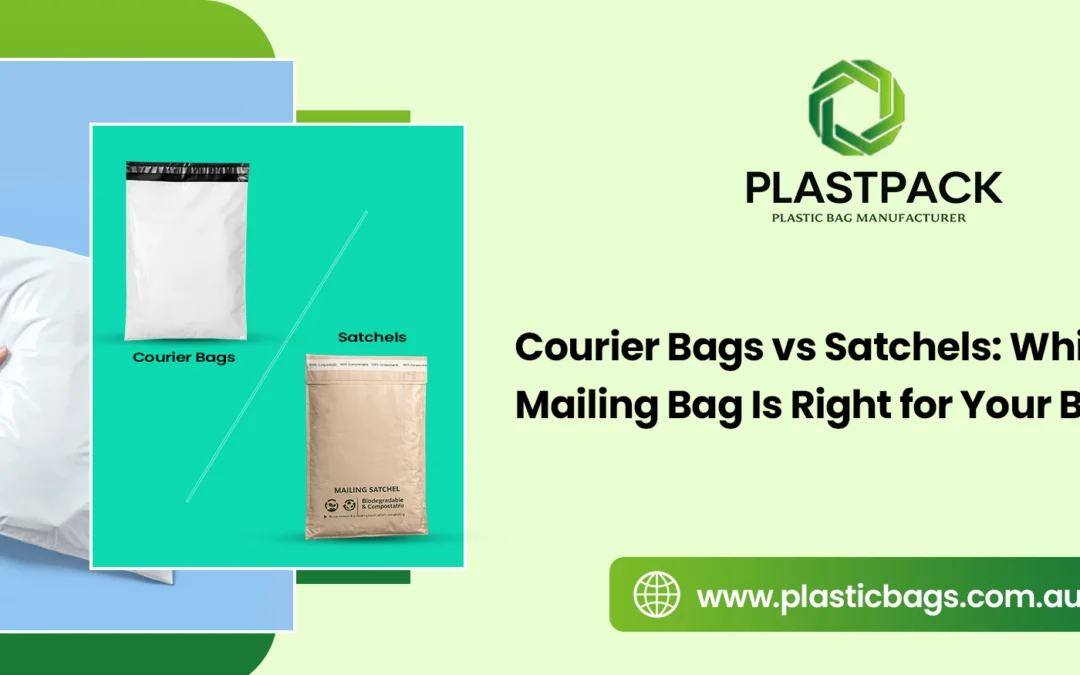
If you run a business that ships products to customers, the mailing bag you use matters more than most people realise. Pick the wrong type, and you end up paying too much per dispatch, dealing with damaged goods, presenting a poor image to customers, or running into security issues. Pick the right one and your dispatch process becomes faster, cheaper, and more professional.
The terms courier bag and satchel are used loosely in the Australian market, sometimes interchangeably, which creates genuine confusion for businesses trying to make the right purchasing decision. In practice, there are meaningful differences among mailing bag formats, and understanding them will help you choose the right option for your specific operation.
At Plastpack, we have been manufacturing plastic bags and packaging solutions for Australian businesses since 1928. Our courier bag range covers standard stock sizes and fully custom-printed options, supplied to e-commerce businesses, logistics operators, retailers, and a wide range of other commercial clients across the country. This guide draws on that experience to give you a clear and practical answer to which mailing bag format is right for your business.
First, a Clarification on Terminology
The Australian packaging market uses several terms that refer to similar or overlapping products. Before comparing formats, it helps to know what people generally mean by each term.
Courier bag: A sealable plastic bag used to send goods via courier or postal services. In Australia, the term is most commonly applied to the plastic poly mailer format, which is made from co-extruded polyethylene film with a peel-and-seal adhesive strip. Courier bags are opaque, weatherproof, tamper-evident, and lightweight. They are sometimes also called poly mailers, plastic mailing bags, or courier satchels.
Satchel: In everyday Australian usage, satchel is a broader term that can refer to plastic courier bags, prepaid postal satchels available from postal services, or padded mailing bags. When a packaging supplier refers to a satchel, they are usually describing the same poly mailer format as a courier bag. When Australia Post refers to a satchel, it means a prepaid postage bag with postage included at a flat rate.
For the purposes of this guide, we use the terms courier bag and satchel to refer to the same core product category: the plastic poly mailer format. Within that category, there are meaningful differences in material, construction, size, finish, and features, and it is those differences that shape the right choice for your business.
We also cover padded mailers as a distinct category, because for some businesses and product types, they are a better choice than standard plastic courier bags.
What Are Plastic Courier Bags Made From?
Understanding the material helps you evaluate quality and choose the right specification for your needs.
Most courier bags and plastic satchels available in Australia are made from co-extruded LDPE (Low-Density Polyethylene) film. Co-extrusion means that two or more layers of polyethylene are bonded together during the manufacturing process to create a single composite film that combines the properties of each layer.
The most common construction is a white exterior layer bonded to a black interior layer, or a black exterior layer bonded to a white interior layer. The white surface on the outside provides a clean background for printing or handwriting addresses. The black interior makes the contents completely opaque, which is important for privacy, particularly when shipping documents, electronics, clothing, or any goods whose contents should not be visible through the bag’s wall.
The film is typically 60 to 70 microns thick for standard courier bags, though heavier-duty options are available at 75 microns and above. The sealing strip is a hot-melt glue strip protected by a peel-off liner that forms a permanent, tamper-evident seal upon activation. Once the liner is removed and the flap is pressed down, the seal cannot be opened without visibly tearing or destroying the bag, making it immediately obvious to the recipient if a bag has been tampered with in transit.
At Plastpack, our courier bags are produced from white/black or black/white co-extruded LDPE film at a standard 65 microns. They are available in custom thicknesses to meet specific requirements and include features such as perforations, tear-off lips up to 90mm, hot-melt glue sealing strips, UV-resistant inks, and UV-stabilised plastic.
Standard Plastic Courier Bags: Key Features and Benefits
For most Australian businesses shipping non-fragile goods, the standard plastic courier bag is the default choice and for good reason. Here is what makes them effective:
Weatherproof and Waterproof
Polyethylene is inherently water-resistant, and a well-constructed courier bag provides reliable protection against rain, humidity, and splashing during transit and outdoor delivery. For Australian conditions, where packages may sit on doorsteps, in uncovered mail areas, or be exposed to wet weather during transit, this is a meaningful practical advantage.
Tamper Evident
The peel-and-seal adhesive strip creates a permanent closure that cannot be opened cleanly without destroying the bag. This makes tampering immediately visible and gives both sender and recipient confidence that the bag has not been opened in transit. For businesses shipping documents, electronics, clothing, supplements, or any goods where authenticity and security matter, this feature is important.
Lightweight
Polyethylene film is very lightweight compared to cardboard or padded alternatives. For businesses where freight costs are calculated by weight, using a lighter bag can reduce cost per dispatch, particularly at high volumes. This advantage compounds significantly when you are dispatching hundreds or thousands of orders per week.
Opaque
The black interior layer makes the contents completely invisible from the outside. This protects the recipient’s privacy, prevents potential thieves from identifying valuable contents, and gives the package a more professional and secure appearance.
Cost Effective
Per unit, standard plastic courier bags are among the most affordable mailing solutions available. When purchased in appropriate quantities, the cost per bag is very low, making them an efficient choice for businesses with high dispatch volumes.
Easy to Use
Peel-and-seal closure requires no tape, no heat sealer, and no additional equipment. A worker packs the item, removes the adhesive liner, folds the flap down, and presses it in place. The whole process takes a matter of seconds, which keeps dispatch times low in busy operations.
Available in Multiple Sizes
Standard courier bag sizes in Australia are typically offered in weight-rated configurations that correspond to common postal and courier rate categories. At Plastpack, we offer standard sizes rated at 500g, 1kg, 3kg, and 5kg, covering the full range of typical e-commerce and business dispatch needs. Custom sizes are also available.
Satchels vs Courier Bags: The Practical Distinction in Australia
As noted earlier, in the Australian context, the word satchel is used in two distinct ways that are worth keeping separate.
Supplier Satchels (Poly Mailers)
When a packaging supplier uses the term “satchel,” they are describing the same product as a courier bag or a poly mailer. The terms are interchangeable in this context, and the product is the plastic co-extruded bag described above. If you are buying from a packaging manufacturer or wholesaler, do not get confused by the terminology; look at the product specifications to understand what you are actually buying.
Prepaid Postal Satchels
Prepaid postal satchels are a specific product sold by Australia Post that includes the postage charge in the purchase price. You buy the satchel at the post office or online, pack your item, seal the satchel, and post it without paying any additional postage. The flat rate covers delivery within Australia up to a defined weight limit, which varies by satchel size.
Prepaid satchels are convenient for very small businesses or infrequent shippers who do not want to work out postage for each item. However, for businesses with moderate to high dispatch volumes, they are almost never the most cost-effective option. Buying plain courier bags in bulk from a manufacturer and arranging postage or courier pickup separately will nearly always be cheaper per dispatch at any meaningful volume.
The key question for your business is whether the convenience of prepaid postage outweighs the premium in cost. For most businesses dispatching more than a handful of orders per week, the answer is no.
Padded Mailers: A Different Category Altogether
Padded mailers, sometimes called bubble mailers, are distinct from standard plastic courier bags and warrant separate consideration for businesses shipping fragile or semi-fragile goods.
A padded mailer has an outer shell (either paper or plastic) lined on the inside with bubble wrap or foam. This padding provides cushioning against impact during transit, protecting contents that could be damaged by being dropped, crushed, or handled roughly.
When Padded Mailers Are the Right Choice
Padded mailers are suited to goods that are fragile or semi-fragile but not so large or heavy that a box is needed. Common examples include:
Jewellery and small accessories, where the item itself is valuable and fragile. Books and printed materials, where bending or corner damage would make the product unacceptable to the customer. Electronics accessories such as cables, earphones, and small devices. Cosmetics and beauty products in glass or hard plastic containers. Fragile ceramics or small decorative items. Documents and certificates printed on heavy stock should not be folded or bent.
For these product types, a standard plastic courier bag without padding provides no meaningful impact protection. If an order is dropped onto a hard surface or compressed under other packages during transit, the contents may arrive damaged. A padded mailer reduces that risk significantly.
Limitations of Padded Mailers
Padded mailers are heavier than standard plastic courier bags, which increases freight costs. They are also bulkier, which can affect how many you can store and how they are processed through automated postal sorting. They cost more per unit than standard courier bags. And they are generally not suitable for very heavy items or anything that needs rigid structural support.
For fragile goods that are large or heavy, a proper shipping box with appropriate internal packaging is a better solution than a padded mailer.
Choosing Between Courier Bags and Padded Mailers: A Direct Comparison
| Standard Courier Bag | Padded Mailer | |
| Material | Co-extruded LDPE polyethylene | Paper or plastic outer with bubble lining |
| Impact protection | None | Moderate |
| Waterproof | Yes | Outer layer only (paper versions may be compromised in heavy rain) |
| Weight | Very light | Heavier |
| Cost per unit | Lower | Higher |
| Tamper evident | Yes | Yes (if peel and seal) |
| Opaque | Yes | Yes |
| Best for | Clothing, documents, non-fragile goods | Fragile items, jewellery, electronics |
| Custom printing | Yes | Yes (outer surface) |
| Freight cost impact | Lower (lighter bag) | Higher (heavier bag) |
Key Factors to Consider When Choosing Your Mailing Bag
What Are You Shipping?
This is the most important question. Non-fragile goods such as clothing, soft accessories, documents, books, supplements in sealed packaging, and similar items ship perfectly well in standard plastic courier bags. Fragile goods need the cushioning of a padded mailer or the rigid structure of a shipping box. Mixed product catalogues may require both formats, used selectively depending on the order.
How Much Does Weight Cost You?
If your shipping is calculated on actual weight, the difference in bag weight between a plastic courier bag and a padded mailer matters. At high volumes, even a small difference in bag weight adds up to a meaningful cost difference over time. Run the numbers for your specific volume and shipping rates to understand the real cost of each option.
What Size Do You Need?
Mailing bags must be large enough to contain the product without overstressing the seams, but not so oversized that the contents shift and move during transit. Using a bag that is too large also increases the chance that the item will be folded or bent if the bag is compressed in a delivery vehicle or postal facility. Matching the bag size to the product is a basic step that many businesses overlook.
The standard size categories of 500g, 1kg, 3kg, and 5kg correspond to the approximate weight capacity of each bag and roughly align with the physical dimensions needed to hold goods in that weight range. If your products consistently sit between categories, it is worth getting a custom size rather than defaulting to a bag that is too large.
Does Your Packaging Reflect Your Brand?
For businesses that invest in their customer experience, the mailing bag is a touchpoint that deserves attention. A generic white bag delivers no brand impression. A custom-printed courier bag with your logo, brand colours, and any messaging you choose turns every delivery into a brand moment.
This matters particularly for e-commerce businesses where the physical product, its packaging, and the delivery bag may be the only tangible brand experience the customer has. Research consistently shows that packaging has a significant effect on how customers perceive and remember a brand. Custom-printed courier bags are not a luxury item reserved for large businesses; at reasonable minimum order quantities, they are an accessible option for small and medium businesses as well.
At Plastpack, our courier bags can be printed in Pantone or CMYK colour schemes to match your brand standards exactly. We also offer UV-resistant inks and UV-stabilised plastics, which ensure printed bags hold their colour and do not fade or degrade from light exposure during transit or storage.
Do You Need Security Features?
For businesses shipping high-value goods, documents, pharmaceuticals, or any item where tampering must be immediately identifiable, the tamper-evident seal is a core requirement rather than a nice-to-have. All standard poly mailer courier bags provide this through the peel-and-seal adhesive strip.
If you need an additional layer of security, some courier bags feature a secondary sealing strip or enhanced tear resistance. For very high-security applications, discuss your specific requirements with a manufacturer who can advise on appropriate specifications.
What Volume Are You Dispatching?
Volume affects both the format you choose and how you source it. At low volumes, the flexibility of buying standard stock sizes from a supplier makes sense. As volume increases, the economics shift in favour of larger orders, custom sizing, and potentially custom printing. A manufacturer with genuine in-house production capability can offer better pricing and faster turnaround at volume than a distributor reselling imported stock.
How Custom Printed Courier Bags Work
For businesses interested in branded mailing bags, here is how the process typically works with a manufacturer like Plastpack.
You provide your artwork in the required format, typically a vector file with exact Pantone or CMYK colour references. The manufacturer prepares printing plates and runs the print onto the film before the bags are formed. The lead time from artwork approval to finished bags is typically 8 to 12 weeks for custom-printed orders, which means forward planning is essential. Minimum order quantities apply to custom-printed bags, though these are generally accessible to small and medium businesses placing regular orders.
The design can include your logo, brand name, website, social handles, care instructions, return address, marketing messages, or any other content that fits within the printable area. Up to six colour printing is available, giving you substantial creative flexibility.
One practical point: custom-printed bags ordered in advance require adequate storage space and should be used within a reasonable timeframe to prevent the film from becoming dusty or the printing from fading in storage. Work with your supplier to order quantities that match your realistic dispatch rate.
Common Mistakes Businesses Make When Buying Mailing Bags
Choosing size by feel rather than measurement. Always measure your typical product dimensions and choose a bag that provides a few centimetres of clearance on each side without excessive empty space.
Buying on price alone. A bag that splits, leaks, or fails to seal reliably costs far more than the savings from the lower unit price. Thin film, poor seams, and weak adhesive strips all create downstream problems.
Using a standard bag for fragile goods. Sending breakables in an unpadded plastic bag and hoping for the best is a recipe for customer complaints and return costs. Match the bag to the product.
Not considering custom printing. Many businesses assume custom printing is expensive or complicated. At reasonable volumes, it is neither. The brand value delivered by a printed bag often outweighs the additional per-unit cost.
Ignoring lead times for custom orders. Custom-printed bags have a lead time of 8 to 12 weeks. Businesses that treat them as quick reorder items end up either switching back to plain bags at short notice or paying premium rates for rush orders.
Ordering too much stock at once. Bags stored for extended periods in poor conditions (heat, UV, humidity) will degrade. Order quantities that you will use within a few months rather than buying a year’s supply and storing it in an outdoor shed.
Why Choose Plastpack for Your Courier Bags?
Plastpack has been manufacturing plastic bags in Australia since 1928. Our courier bags are manufactured in-house at our Australian facility, which means we control quality at every stage from film extrusion through to bag forming and sealing strip application.
Our standard courier bags are produced from co-extruded white/black or black/white LDPE film at 65 microns, with hot melt glue sealing strips, UV-resistant inks, UV-stabilised plastics, and optional non-slip embossed film. Standard sizes include 500g, 1kg, 3kg, and 5kg. Custom sizes and thicknesses are available. Full-custom printing in Pantone or CMYK is available, with 8 to 12-week lead times for printed orders.
We hold approximately 50 tonnes of film stock at our facility, which allows us to manufacture and dispatch orders efficiently without the long delays associated with imported stock. Whether you need plain stock courier bags or fully custom-printed bags for your brand, our team can help you determine the right specification for your application.
Frequently Asked Questions
What is the difference between a courier bag and a poly mailer?
There is no meaningful difference. Poly mailer, courier bag, courier satchel, and plastic mailing bag all refer to the same product: a co-extruded polyethylene bag with a peel-and-seal adhesive strip used for shipping goods via courier and postal services. The terminology varies between suppliers and regions, but the underlying product is the same. Always check the specifications rather than the name when comparing products.
Are Plastpack courier bags suitable for e-commerce businesses?
Yes. Our courier bags are well-suited to e-commerce operations of all sizes, from small online retailers dispatching a few orders per day through to larger operations with high daily dispatch volumes. They are available in standard sizes covering the typical weight categories used by Australian courier services, and custom-printed options are available for businesses that want to present a branded delivery experience to their customers.
What size courier bag do I need for my products?
Choose a bag size that fits your product, with a few centimetres of clearance on each side and enough room at the top to seal the flap without pressing the contents directly against the adhesive strip. Our standard sizes, rated at 500g, 1kg, 3kg, and 5kg, cover most common product sizes, and custom dimensions can be manufactured if your products consistently fall between standard sizes. Contact our team, and we can help you work out the right fit.
Can I get courier bags custom-printed with my logo?
Yes. Plastpack offers full custom printing on courier bags in Pantone or CMYK colours, with up to 6-colour printing available. We use UV-resistant inks and UV-stabilised plastics to ensure printed bags hold their colour during storage and transit. Custom printed orders have a lead time of approximately 8 to 12 weeks from artwork approval, so plan your first order well in advance of when you need stock.
Are your courier bags tamper-evident?
Yes. All our courier bags use a hot-melt glue peel-and-seal adhesive strip that creates a permanent, tamper-evident closure once activated. Once the protective liner is removed and the flap pressed down, the bag cannot be opened without visibly tearing or destroying the film, making any tampering immediately obvious to the recipient. This is a standard feature across our courier bag range and is important for businesses shipping documents, high-value goods, or any item where security in transit matters.
Plastpack (formerly Churchill & Coombes) is an Australian manufacturer and supplier of plastic bags and packaging film, based in New South Wales. We supply businesses and operators across Australia with a wide range of bag products, including courier bags, carry bags, industrial bags, and custom printed packaging. Contact us at sales@plasticbags.com.au or call 02 9649 6111.