
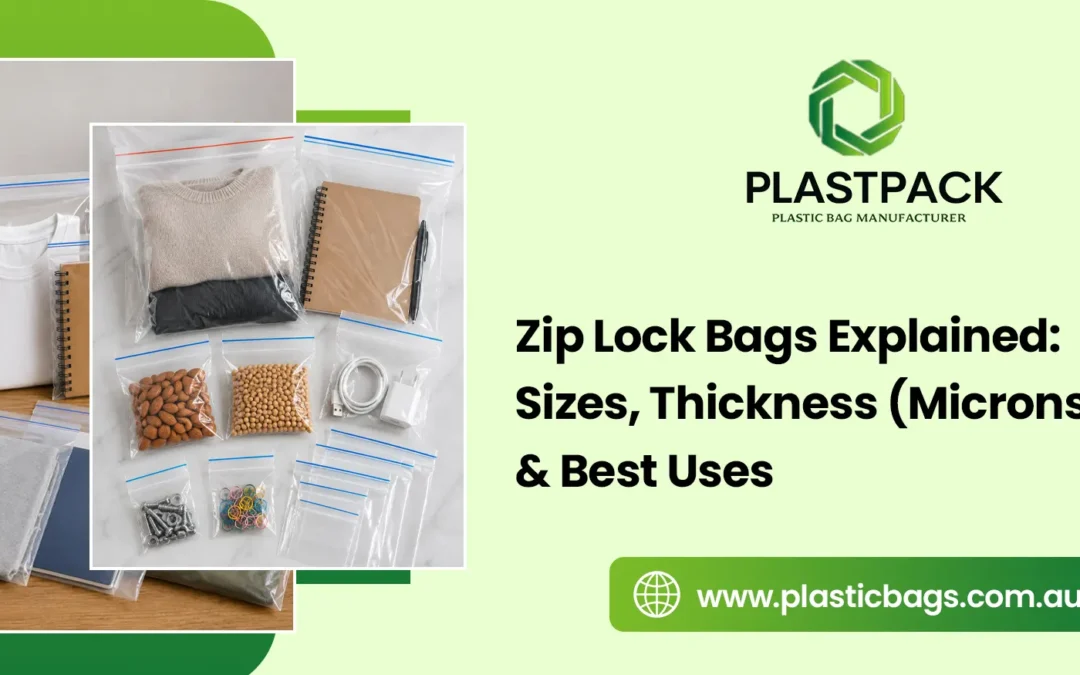
Zip lock bags look simple, but the version that works for a jeweller packing tiny findings is not the one a workshop needs for sharp fixings, and neither is the one a food business should put produce in. Getting the size, the thickness and the film right is what separates a bag that holds its seal from one that splits in the carton.
This guide breaks down the three things buyers actually need to decide on: what size to order, how thick the film should be, and which bag suits which job. Plastpack manufactures zip lock bags in Australia, extruding the film, printing it and forming every bag in our own facility, so the advice here comes from making the product rather than reselling it.
What is a zip lock bag?
A zip lock bag is a plastic bag with an interlocking channel along the opening that presses closed by hand and reopens as often as you need, with no heat, tape or clips. Around Australia, the same bag goes by several names: ziplock bag, zip lock bag, snap lock bag, resealable or reusable plastic bag, zip seal bag, grip seal bag, clip lock bag or poly ziplock bag. Press seal is the trade term for the same closure.
Whichever name you use, it is one product family. Most are made from LDPE film, which gives a clear wall and a firm, repeatable seal.
Zip lock bag sizes and how they are measured
Zip lock bag sizes are given as Opening x Depth in millimetres, with the depth measured from the seal down. The opening is the width across the top where the bag presses shut, and the depth is how far the bag runs below that seal. Reading the size this way stops the common mistake of ordering a bag that is wide enough but too shallow to hold the product below the closure.
Stock sizes run from small bags of around 50 x 75 mm, suited to tablets, beads and fixings, up through larger sizes for bulkier goods, all in the same clear film. When a stock size does not match your product, the bag can be made to your exact dimensions. As a quick method, measure your item at its widest and longest points, then choose an opening a little wider and a depth that leaves room below the seal.
Zip lock bag thickness explained (microns)
Thickness is measured in microns, written as µm or um, where one micron is 0.001 mm. It describes the thickness of the film wall. This is worth checking when you compare suppliers, because some quote a doubled figure that counts both walls of the bag, which can make a bag look thicker than it is. Compare like for like on the single wall gauge.
Plastpack runs three core lines, and the right one comes down to what goes inside:
The 50 micron bag is the everyday standard for samples, small parts, retail items and general storage. The clear film keeps contents visible and the closure gives a firm, repeatable seal.
The 75 micron heavy duty bag is for sharp, heavy or abrasive contents such as fixings, hardware and components. The thicker wall resists splitting and holds its seal through handling and transport. Our heavy duty 75 micron zip lock bags are the pick where a standard bag would tear.
The write-on panel bag pairs the same closure with a matte white panel for labelling by hand, which suits dates, batch numbers, contents or specimen details written straight onto the bag. See our write-on panel press seal bags for the option.
As a rule, light items and short storage are fine on 50 micron. Heavy, sharp or frequently handled contents call for 75 micron so the bag does not split at the seal. If you are unsure, tell us the weight and edge profile of the product, and we will point you to the right gauge.
Best uses for zip lock bags
Zip lock bags earn their place because they open and reseal by hand with no extra tape, heat or fasteners. That makes them useful across a range of commercial settings:
Food businesses use them for portioning, dry goods, produce and resealable retail packs. Food-contact use calls for the correct film, covered below.
Medical, clinical and laboratory operations use them for samples, small components and specimen storage, where the write-on panel is handy for recording details directly on the bag.
Industrial and hardware businesses use the 75 micron bags for fixings, fasteners, spare parts and components, where a firmer wall stands up to sharp edges.
Retail and eCommerce sellers use clear zip lock bags to display and protect small items, keep multi-part products together and present accessories at point of sale.
Warehousing and general operations use them to organise small parts, kit up orders and keep loose items grouped and labelled.
Food-grade zip lock bags
If the bag touches food, the film matters. We manufacture food-grade sealable bags for food-contact use, made to the relevant Australian food safety requirements, and they suit portioning, dry goods, produce and resealable retail packs. A general-purpose bag is not automatically food-grade, so tell us the bag is for food when you enquire and we supply the correct film for the job.
Why clear film matters
Most zip lock bags are made from clear LDPE so the contents are visible without opening the bag. For retail display, stock picking and inventory checks, that visibility speeds up handling and cuts mistakes. Where you would rather label than show, the write-on panel gives you a clean surface for handwriting while keeping the resealable closure. For more on where clear packaging fits, see our guide to clear plastic packaging bags.
Buying zip lock bags in bulk and custom sizes
For businesses using bags in volume, ordering direct from the manufacturer keeps the supply consistent and the lead times short. We supply zip lock bags in bulk across Australia, and because we hold around 50 tonnes of film at the factory, the material for most orders is already on site. For regular buyers, we can hold your size and spec on file so reordering is a phone call.
When an off-the-shelf size does not fit, we make the bag to your spec: your size, thickness, seal and print, with up to six-colour printing in-house for branding, handling instructions or compliance text. The minimum for a custom-size run is 10,000 bags. If you are planning a larger packaging order, our guide on buying plastic bags wholesale covers how to lock in a reliable bulk supply.
To match zip lock bags to your product, contact the Plastpack team with your size, quantity and what goes inside, and we will recommend the right size, gauge and film.
Frequently asked questions
What thickness zip lock bag do I need?
Use 50 micron for light contents and general storage such as samples, retail items and small parts. Step up to 75 micron heavy duty for sharp, heavy or often-handled contents like fixings and hardware, so the bag does not split at the seal.
How are zip lock bag sizes measured?
Sizes are given as Opening x Depth in millimetres, with the depth measured from the seal down. The opening is the width where the bag presses shut, so measure your product at its widest and longest points and allow a little extra on both.
Are zip lock bags food safe?
Only if they are made from food-grade film. Plastpack manufactures food-grade sealable bags for food-contact use, made to the relevant Australian food safety requirements, so tell us the bag is for food when you enquire, and we supply the correct film.
What is the difference between zip lock bags and press seal bags?
There is none in practice. Zip lock, press seal, snap lock, grip seal and resealable all describe the same bag with an interlocking closure that presses shut by hand and reopens as needed.
Can I buy zip lock bags in bulk or in a custom size?
Yes. We supply zip lock bags in bulk Australia-wide and, as the manufacturer, produce custom sizes, thicknesses, seals and printing to order. The minimum for a custom-size run is 10,000 bags.