
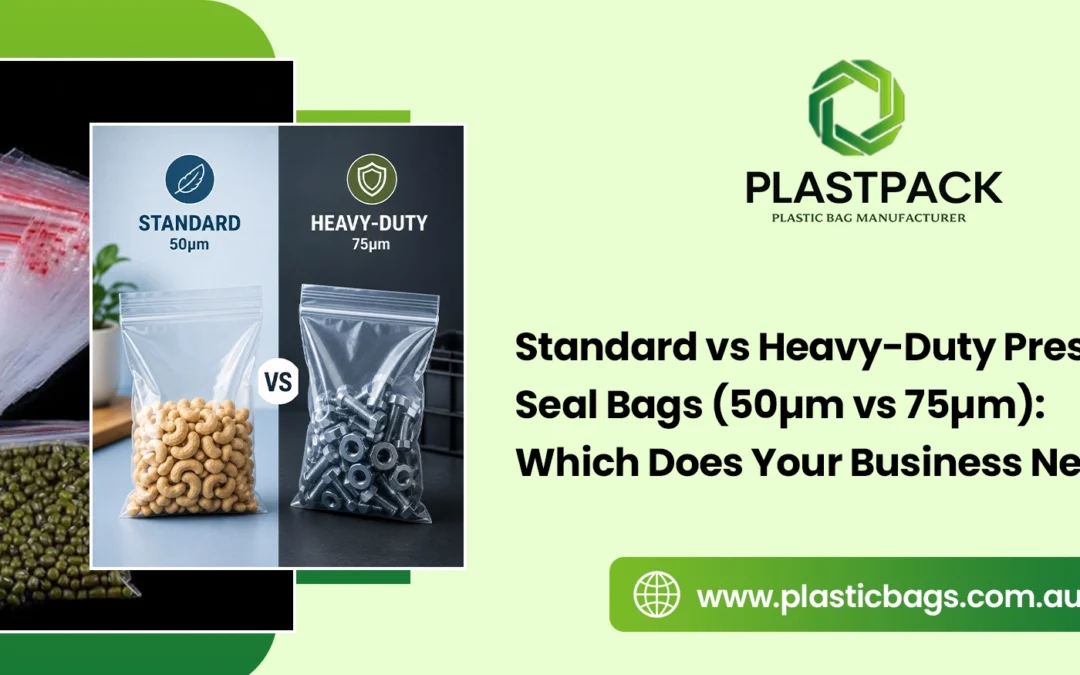
Most businesses reach for a press seal bag without thinking twice about the gauge printed on the spec sheet. That number matters more than it looks. The difference between a 50µm and a 75µm bag decides whether your product arrives sealed and intact or whether you spend the week fielding complaints about split seams and torn corners.
Here is the short answer. Standard 50µm press-seal bags suit light- to medium-weight contents that need a clean reseal: documents, small components, sample portions, retail and food items that are not heavy or sharp. Heavy-duty 75µm press-seal bags are built for weight, edges, and repeated handling: hardware, mechanical parts, dense food products, and anything that moves through a warehouse or freight network more than once. If the bag fails on the job, move up a gauge.
Below is the full picture so your procurement, production and warehouse teams can specify with confidence.
What “micron” actually tells you
A micron (µm) is one thousandth of a millimetre, and it measures the thickness of the film. Higher micron, thicker wall, more resistance to tearing, puncturing and stretching under load. At Plastpack, formerly Churchill & Coombes, our standard press seal bags are 50µm and our heavy-duty range is 75µm, with write-on panel bags also at 50µm.
Thickness is not the only thing driving strength. Film quality, the way it is extruded, and how the seal is formed all play a part. A well-made 50µm bag from quality film often outperforms a cheaper, thicker bag made from inconsistent stock. That is one reason we extrude our own film and form our own bags in-house rather than reselling someone else’s, so the gauge you order is the gauge you get, batch after batch.
50µm vs 75µm at a glance
| Feature | Standard 50µm | Heavy-Duty 75µm |
| Film thickness | 50 microns | 75 microns |
| Best for | Light to medium contents | Heavy, sharp or bulky contents |
| Puncture resistance | Good | High |
| Reseal durability | Suited to occasional reopening | Holds up to repeated handling |
| Typical contents | Documents, small parts, samples, retail items, food portions | Components, fasteners, dense food products, potting mixes, freight items |
| Tear risk under load | Moderate as weight rises | Low |
| Material cost per bag | Lower | Higher |
| Reference feel | Similar to a household snap-lock sandwich bag | Closer to a heavier component or potting mix bag |
Standard 50µm press seal bags: where they earn their place
A 50µm bag is the workhorse of resealable packaging. The wall is thick enough to protect contents from dust, moisture and handling, and the press seal closes cleanly without tape or heat. For high volume tasks where each bag holds something light, 50µm keeps your packaging spend in check while still doing the job properly.
Good fits include:
- Retail and point of sale items, spare buttons, jewellery and small accessories
- Document control, instruction cards and paperwork are kept with the product
- Food portions, dry goods and ingredients that are not heavy or abrasive
- Sample dispatch and kitting, where many small items are bagged at speed
- Parts that need to be visible, labelled and resealed during assembly
Where 50µm starts to struggle is with weight and edges. Load it with a heavy fitting, a sharp bracket or a dense product and the film works harder than it was designed to. That is the signal to step up.
Heavy-Duty 75µm press seal bags: built for the hard jobs
Heavy-duty 75µm press seal bags carry roughly half as much film again, and you feel it the moment you handle one. The extra wall resists puncture from corners and threads, holds its shape under weight, and stands up to being opened, refilled and resealed across a shift.
Reach for 75µm when the contents include:
- Mechanical fittings, fasteners, screws and metal components with sharp edges
- Heavier food products and bulk dry goods, where the bag weight adds up
- Items that travel through a warehouse, courier or freight network and get knocked about
- Anything that needs to be reopened and resealed repeatedly without the seal giving out
- Granular or abrasive contents, such as mixes that scuff thinner film
In practice, the cost difference per bag is small against the cost of a single failed dispatch: the return, the replacement product, the freight and the time. For demanding workflows, the heavier gauge usually pays for itself.
Which does your business need? A quick decision guide
Match the gauge to the heaviest, sharpest thing the bag will carry, not the average.
Food manufacturers and packers. Light portions, dry ingredients and produce that is gentle on film sit comfortably in a 50µm food-grade press seal. Move to 75µm for heavier product, bulk fills, or anything with edges. Specify food-grade film either way and keep contamination control at the front of your mind.
Medical, clinical and pharmaceutical. Specimen handling and parts kitting often call for the security and integrity of a heavier 75µm wall, particularly where a reliable, consistent seal is part of your procedure. Always align the product to the relevant standards and your facility’s documented protocols.
Industrial, workshops and manufacturers. Fittings, fasteners and sharp components belong in 75µm. The puncture resistance alone justifies the gauge, and the reseal survives the repeat handling typical of a parts bin or assembly line.
Couriers, eCommerce and logistics. If the bag is going to be thrown, stacked and scanned across a network, 75µm protects the contents and your brand. For lighter, soft items, 50µm keeps costs down without risking the dispatch.
Retail and point of sale. Most retail uses are well served by 50µm, with the option of a write-on panel bag where staff need to label contents by hand.
Still unsure between the two? Order a sample of each, run them through your real workflow, and watch for tears, seal failures and returns. The right gauge shows itself quickly. Our thickness reference guide gives further everyday comparisons if you want a feel for how each micron level performs.
Custom press seal bags made to your spec
Stock sizes cover most needs, and our standard range comes in box quantities of 1,000, with sizing measured as opening by depth from the seal. When the job needs something specific, we make it.
- Made-to-measure sizes, with custom press seal runs from a minimum of 10,000 bags
- Up to six-colour custom printing for branding, product detail or handling information
- Write-on panel bags for manual labelling at 50µm
- Food-grade film for a product that needs it
Because we run film extrusion, printing and bag forming under one roof at our Australian facility, with substantial film stock held on site, we keep lead times short and supply steadily. That matters when a packaging shortage can stall a production line or a dispatch run.
Frequently asked questions
Is a 75µm press seal bag always stronger than a 50µm bag?
For the same film and build, yes, the 75µm bag resists tearing and puncturing better because the wall is thicker. Build quality still counts, though. A quality 50µm bag can outperform a poorly made thicker one, which is why consistent film and sealing matter as much as the gauge number.
What is the difference between standard and heavy-duty press seal bags?
Standard press seal bags are 50µm and suit light to medium contents. Heavy-duty press seal bags are 75µm and are made for heavier, sharper or bulkier items and for packaging that is handled repeatedly. Both use the same press-to-close seal that reopens and reseals without tape or heat.
Are press seal bags food-safe?
They can be when specified in food-grade film. Tell us the bags are for food contact at the time of ordering, so the correct film and product are matched to the application.
Can I get press seal bags printed with my branding?
Yes. We offer up to six-colour custom printing on press seal bags, useful for logos, product information and handling instructions. Custom printed press seal runs have a minimum order quantity.
How do I know which micron to choose?
Specify for the heaviest and sharpest contents the bag will hold, not the typical load. If your team is seeing split seals or torn bags on 50µm, move to 75µm. When you are between gauges, request samples of both and test them in your own workflow.
What size press seal bags are available?
Sizing is measured as opening by depth, with depth taken from the seal. We hold an extensive range of stock sizes and can produce custom sizes to order. Talk to us with your dimensions, and we will quote on the right specification.
Need help matching the gauge to your application? Browse the full press seal bag range or request samples, and our team will help you specify the right product for the job.