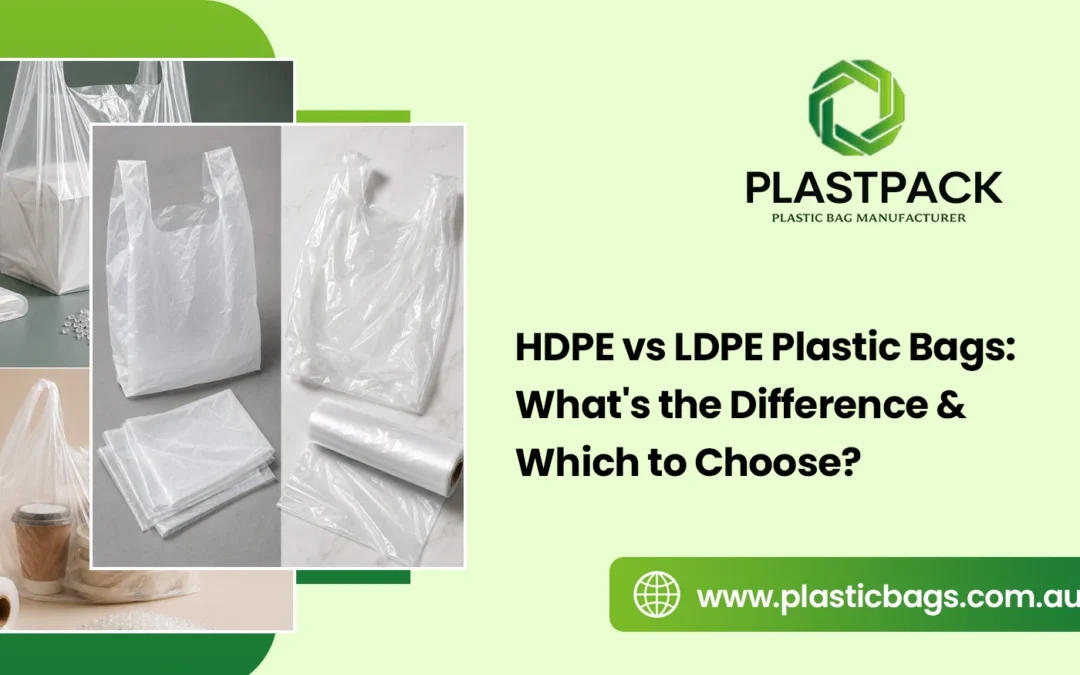
If you order plastic bags in bulk, one detail on the spec sheet quietly decides how the bag performs on the floor: whether it is made from HDPE or LDPE. Both are polyethylene, both are food-safe when made to the right standard, and both are sold by the carton. But they behave very differently, and choosing the wrong one shows up later as split liners, cloudy retail bags, or paying for more material than the job needs.
Here is the short version for busy buyers. HDPE is stiffer, crinkly and strong for its weight, which suits dry waste liners, singlet and checkout bags, and carton liners. LDPE is softer, clearer and more flexible with better puncture and tear resistance, which suits produce, freezer and food storage bags, heavier or wet loads, and press seal packs. Choose HDPE when you want the most bags from the least material and stiffness helps. Choose LDPE when flexibility, clarity and load protection matter more.
The rest of this guide breaks that down properly so your procurement, production and warehouse teams can match the right film to each task.
What is HDPE (high-density polyethylene)?
HDPE is a tightly packed polyethylene with very little branching in its polymer chains. That dense structure makes the film stiff, strong for its thickness, and slightly cloudy rather than glass-clear. It is the material behind the classic supermarket singlet bag: thin, noisy, and surprisingly strong when you consider how little plastic is in it.
Because HDPE gives a high strength-to-weight ratio, you get more bags per kilogram of film. It also holds a firmer moisture barrier and copes with higher temperatures than LDPE. The trade-off is flexibility. HDPE does not stretch much, so once the film is nicked by something sharp, it can split more readily than a softer film would.
This strength at low micron is why HDPE is the standard film for commercial garbage bags, where a 16 micron bag still carries a full bin load.
What is LDPE (low-density polyethylene)?
LDPE has a more branched structure, which leaves more space between the chains and makes the film soft, stretchy and clear. It is the material most people picture as a “plastic bag”: a smooth, glossy, see-through film that gives a little when you pull it.
That flexibility is the point. LDPE stretches around awkward shapes, absorbs impact, and resists punctures and tears far better than HDPE under wet or heavy loads. It also offers excellent clarity, so a product stays visible through the bag. This is why LDPE is the default film for plain poly bags, produce and freezer bags, press seal bags, and layflat poly tubing that gets cut to length on site.
Where loads turn sharp or abrasive, LDPE steps up, which is why our heavy duty bin liners run from 50 to 150 micron in LDPE.
HDPE vs LDPE: the key differences at a glance
| Property | HDPE | LDPE |
| Feel | Thin, stiff, crinkly, noisy | Soft, smooth, stretchy, glossy |
| Strength character | High tensile strength for its weight | High puncture and tear resistance |
| Flexibility | Low, holds its shape | High, stretches under load |
| Clarity | Translucent, slightly cloudy | Clear, good product visibility |
| Wet or sharp loads | Can split once punctured | Holds up well |
| Moisture barrier | Firm | Good |
| Heat tolerance | Higher | Lower |
| Recycling code | 2 | 4 |
| Best suited to | Dry waste liners, singlet and checkout bags, carton liners | Produce, freezer and food bags, press seal, heavy or wet loads |
How to tell HDPE and LDPE apart on the job?
Your team can identify the two by feel in seconds, which is handy when a delivery arrives without clear labelling. HDPE feels thin and rigid, makes a distinct crinkly, papery sound, and is usually opaque or lightly tinted. LDPE feels soft and smooth, stretches slightly when you pull it, and looks clearer and glossier. If it sounds noisy and stiff, it is HDPE. If it feels quiet and flexible, it is LDPE.
Which should you choose? A decision guide by sector
The right resin depends less on the label and more on the load, the environment and the standard you have to meet. Here is how the choice usually falls across the sectors we supply.
Food manufacturing and food service
LDPE is the workhorse here. Its softness and clarity make it ideal for produce, bread, portioned meat and fish, and freezer storage, and it stays flexible at low temperatures without becoming brittle. HDPE still earns its place for stiffer carton liners and dry food handling where rigidity helps the liner sit up inside a box. Both can be produced to food-contact standard, so the material is only half the decision; the grade and gauge matter just as much.
Medical, clinical and pharmaceutical
This is specification-led territory. Bag choice here is driven by the standard and the procedure, not by feel, and the film is matched to the application. For regulated waste streams, products such as clinical waste bags are made to a defined colour, thickness and marking. Always match the bag to the relevant regulations and your facility’s approved procedures rather than choosing on material properties alone.
Industrial, warehousing and waste
For light, dry waste, such as paper and office bins, HDPE liners give you more bags per roll and enough strength for the job. For heavy, wet or sharp waste, LDPE or an LDPE blend resists splitting far better and is worth the extra film. HDPE and LDPE also cover carton lining, dust protection, component containment and transit packaging across manufacturing and warehousing.
Retail and carry
Singlet and checkout carry bags are a natural fit for HDPE, where a high strength-to-weight ratio keeps cost per bag down while still carrying the load. Where a premium look or a printed brand finish matters, a softer, clearer film often reads better on the shelf and in the hand. If branding is part of the brief, custom printed bags can be produced in either material with print applied to the film before the bag is formed.
Courier, eCommerce and logistics
Fulfilment operators need a bag that survives the parcel network without tearing. Strong, flexible film with a reliable seal is the priority, which is why courier bags are built for tamper-evidence and load strength rather than clarity. Custom print is a practical add-on for anyone moving volume under a recognisable brand.
Agriculture and horticulture
Outdoor and bulk applications lean on tougher, thicker film that copes with UV, moisture and rough handling. Load weight and exposure decide the gauge, and heavier LDPE or blended films are common for durable, made-to-size requirements.
Where does LLDPE fit in?
You will also see LLDPE (linear low-density polyethylene) on spec sheets. It sits between the two: it keeps much of LDPE’s flexibility while adding stronger puncture and tear resistance, because its short branches slide under stress instead of tearing straight through. LLDPE is often blended into heavy-duty liners and industrial film where a bag has to stretch and take a beating at the same time. When a job needs both give and grunt, an LLDPE blend is frequently the answer.
Getting the gauge and seal right
Resin is only one of three settings that decide how a bag performs. The other two are thickness and seal type, and getting all three right is where a made-to-spec order pays off.
Thickness is measured in microns, and heavier is not always better; it is about matching the film to the load. Light, dry contents sit comfortably on a thinner gauge, while heavy, wet or sharp contents need more wall to stay intact. Seal type then shapes how the bag is built. Bottom seal bags are formed from a single extrusion with a sealed base, which gives a clean internal surface and runs well on automated heat-sealing lines. Side seal bags are produced from layflat tubing and suit general packing. If you buy across several sizes and volumes, our wholesale plastic bags guide walks through matching specification to order size.
Recyclability and responsible material choice
Both films are recyclable, but they are not recycled together. HDPE carries resin identification code 2, and LDPE carries code 4, and the two streams are processed separately. Keeping them apart, and following your local commercial recycling arrangements, is the practical step most operations can take.
The bigger environmental win often comes earlier, at the specification stage. Choosing the correct film and gauge for the job means fewer failed bags, less double-bagging and less wasted material overall. Where a genuinely lower-impact option applies, biodegradable and degradable lines are available, and we only describe a product as biodegradable or recyclable where that specific product actually is.
Why buy HDPE and LDPE bags from a manufacturer, not a reseller?
Most suppliers ranking for these products hold whatever a third party produced, which limits the sizing, thickness and turnaround you can get. Plastpack works differently. We extrude our own film, print it and form the bags in-house at our Australian facility, with a heritage in the trade dating back to 1928. Because we control the process from film to finished bag, we can produce either HDPE or LDPE, in blends, at the exact thickness, colour and seal your application calls for, in up to six-colour print.
We also hold a large volume of film stock on site, so the material for your order is usually already in the factory, ready to run. That keeps lead times short and dispatch fast across Australia. If you are unsure which resin, gauge or seal suits your operation, our team can help you specify it and provide samples to evaluate before you commit to a run. Browse the full plastic bags range or ask us to quote a made-to-spec order.
Frequently asked questions
Is HDPE or LDPE stronger?
HDPE has higher tensile strength for its weight and feels stiffer, but LDPE resists punctures and tears better under wet or sharp loads. The stronger choice depends on the load, not the label.
Which is better for food packaging, HDPE or LDPE?
Both can be made to food-contact standards. LDPE is the usual pick for produce, freezer and food storage because it is soft and clear, while HDPE suits stiffer carton liners and dry food handling.
Can I recycle HDPE and LDPE bags together?
No. HDPE carries resin code 2, and LDPE carries code 4, so they are processed separately. Keep the streams apart and follow your local commercial recycling arrangements.
How do I tell HDPE and LDPE apart?
HDPE feels thin, stiff and crinkly and often sounds noisy, like a supermarket singlet bag. LDPE feels soft, smooth and stretchy with a glossier, clearer look, like a produce or freezer bag.
Which resin should I choose for bin liners?
HDPE suits light, dry office and paper waste where you want more bags per roll. For heavy, wet or sharp waste, LDPE or an LLDPE blend holds up far better without splitting.