Plastic bags are one of the most misunderstood items in Australian recycling. Half the country still drops them in the kerbside bin hoping for the best, and that single habit causes real problems at the sorting facility. So let’s clear it up for 2026.
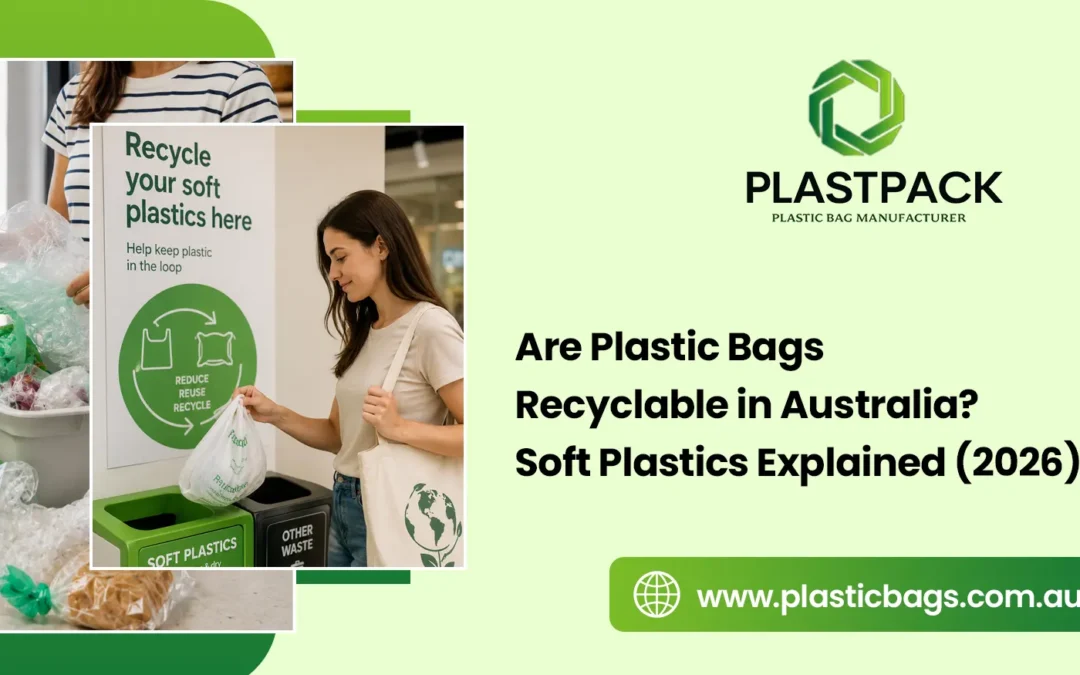
Yes, plastic bags are recyclable in Australia. No, they do not belong in your household yellow-lidded bin. Soft plastics like bags and wrappers need a dedicated collection stream, either a supermarket drop-off point for household quantities or a commercial soft plastic recycler for business volumes. Put them in the kerbside bin and they tangle the machinery and contaminate everything around them.
This guide explains how soft plastics recycling actually works in Australia right now, what changed after REDcycle, which bags are easiest to recycle, and what your business can do with its soft plastic waste.
Are plastic bags recyclable in Australia? The short answer
Plastic bags are technically recyclable, but only through the right channel. Single-use plastic bags are recyclable, but not via the household recycling bin, because soft plastics can contaminate other recyclables and get caught in recycling machinery. They have to be collected separately, kept clean and dry, and sent to a facility set up to process film plastic.
For households, that means a soft plastics collection point. For businesses generating film at volume, it means a commercial recycler who can take clean, baled poly. Both routes work. The kerbside bin does not.
Why can’t plastic bags go in the kerbside recycling bin?
Kerbside recycling is sorted by machines built for rigid items: bottles, cans, jars and cardboard. Soft, floppy film behaves nothing like those. Soft plastics wrap around the spinning parts of sorting equipment, jam the machinery, and contaminate other recyclable materials. A bag that could have been recycled in the right stream can ruin an entire load of otherwise good recycling once it goes in the wrong bin.
That is why the rule is consistent across councils: keep soft plastics out of the yellow bin, and use a collection stream designed for them.
What happened to REDcycle?
For most of the last decade, one program handled household soft plastics in Australia. REDcycle ran in-store drop-off bins at Coles, Woolworths and Aldi across around 2,000 supermarkets. As collections grew, the program took in more material than its processing network could handle, and excess soft plastics were stockpiled. The program collapsed in November 2022, and investigators later found around 11,000 tonnes of soft plastic stockpiled across 44 locations in New South Wales, Victoria and South Australia.
The collapse left a lot of confusion, and it is the main reason so many people are still unsure whether their bags can be recycled at all. The honest answer is that the collection network had to be rebuilt from the ground up, and that rebuild is now well underway.
How soft plastics recycling work in Australia in 2026?
The system that replaced the old model is more careful about matching collection to real processing capacity. A national scheme is now run by Soft Plastics Stewardship Australia, an independent not-for-profit that received an eight-year authorisation from the ACCC in November 2025 with strict transparency conditions. Unlike the previous model, it operates separately from retailers and manufacturers, with mandatory public reporting, and it is designed not to accept more material than processors can actually handle.
Collection has scaled back up. There are now more than 700 collection points operating in supermarkets across New South Wales, Victoria, Queensland, South Australia and the ACT, with processing capacity of more than 20,000 tonnes of soft plastics a year, close to three times REDcycle’s peak.
Just as important, there are now facilities to process the material domestically. A dedicated soft plastics facility near Taree in New South Wales, operated by iQRenew, can process up to 14,000 tonnes a year with plans to expand, sorting, washing and converting used film into raw material that manufacturers can reuse. Other processors turn collected film into building panels now installed in Woolworths stores, and into additives for concrete and asphalt, while some supermarket bread bags now contain recycled soft plastic sourced from in-store collection. That last point matters, because it shows soft plastic being recycled back into packaging rather than only into low-grade products.
Schemes and facilities are still expanding through 2026, so coverage keeps improving. The direction of travel is clear: soft plastics recycling is back, and it is being built to last this time.
What counts as a soft plastic? The scrunch test
The easiest way to tell a soft plastic from a rigid one takes a second. Scrunch the item in your hand. If it stays scrunched, it is a soft plastic. If it springs back into shape, it is a rigid plastic and belongs in a different stream.
Here is how common items sort out.
| Soft plastics (scrunch test passes) | Not soft plastics |
| Plain poly bags and shopping bags | Rigid bottles and containers |
| Bread bags and produce bags | Meat trays and punnets |
| Pallet wrap and shrink film | Expanded polystyrene foam |
| Bubble wrap and void-fill film | Anything with food residue left on it |
| Bin liners and courier satchels | Multi-layer laminated pouches (often not accepted) |
Cleanliness is the deciding factor either way. Film that is contaminated with food, liquid or other rubbish usually cannot be recycled, so keeping it clean and dry is the single most useful thing you can do.
Which plastic bags are recyclable?
Not all bags are equal at the recycling facility. The easiest to recycle are single-material bags made from one type of polyethylene. Low-density polyethylene, marked with recycling code 4, and high-density polyethylene, marked with code 2, are both widely accepted in soft plastic streams. Most everyday poly bags, including plain poly bags and layflat film, are made from one of these.
The bags that cause trouble are multi-layer or laminated films that combine plastic with foil or other materials. These are difficult to separate back into usable raw material, which is why many are not accepted. If recyclability matters to your operation, a clean single-material poly bag is a far better starting point than a mixed-material laminate. Products made from a single resin, such as layflat poly tubing and press seal bags, keep the recycling path simple.
Soft plastics recycling for businesses
Most recycling advice is written for households, but businesses generate far more soft plastic, and they have a cleaner, more valuable stream to work with. Clean back-of-house film such as pallet wrap, poly bags and shrink film is exactly what commercial recyclers want, because it arrives in volume and is usually free of the food contamination that spoils household collections.
The practical steps for a business are straightforward. Keep film separate from general waste at the point it is generated. Keep it clean and dry. Where you have the space, bale or bag it so it is ready for collection. Then arrange pick-up through a commercial soft plastic recycler rather than relying on the supermarket bins, which are intended for household quantities. Done well, this turns a waste cost into a recovered resource and cuts what goes to landfill.
For food, medical and industrial operations that already separate their waste streams, adding a clean soft plastics stream is a small change with a real payoff. If you are reviewing packaging across several sites, our wholesale plastic bags guide can help you standardise on materials that are simpler to recover.
How the right packaging choice reduce soft plastic waste?
Recycling is only part of the picture. A lot of soft plastic waste is created before a bag is ever used, through over-specification and mismatched packaging. Choosing the correct film, thickness and size for the job means fewer failed bags, less double-bagging and less material heading to the waste stream in the first place.
As a manufacturer, Plastpack makes this easier in a few ways. We produce single-material poly bags in recyclable LDPE and HDPE, which keeps the recycling path clean compared with mixed-material laminates. Where a genuinely lower-impact option suits the application, biodegradable and degradable lines are available, and we only describe a product as recyclable or biodegradable where that specific product actually is. And because we extrude our own film and form bags to spec, we can help you right-size packaging so you buy and discard less. Browse the full plastic bags range, including custom printed options, or ask our team to help you specify a material that fits your operation and your waste goals.
Frequently asked questions
Can I put plastic bags in my kerbside recycling bin?
No. Plastic bags and other soft plastics tangle in sorting machinery and contaminate other recyclables. They need a dedicated soft plastics collection point or a commercial recycler, not the household yellow bin.
Are plastic bags recyclable in Australia in 2026?
Yes. Clean, dry soft plastics can be recycled through the national scheme run by Soft Plastics Stewardship Australia and through commercial recyclers. The material is turned into products such as building panels, road base and new packaging.
What is the scrunch test?
Scrunch the plastic in your hand. If it stays scrunched, it is a soft plastic like a poly bag or bread bag and belongs in a soft plastics stream. If it springs back, it is a rigid plastic for a different stream.
Which plastic bags are easiest to recycle?
Single-material bags made from LDPE (code 4) or HDPE (code 2), such as plain poly bags, are the easiest to recycle. Multi-layer or laminated films with mixed materials are much harder and often not accepted.
How should a business recycle its soft plastic waste?
Keep film clean, dry and separated from other rubbish, then bale or bag it for collection by a commercial soft plastic recycler. Clean back-of-house film such as pallet wrap and poly bags has real recycling value at volume.