
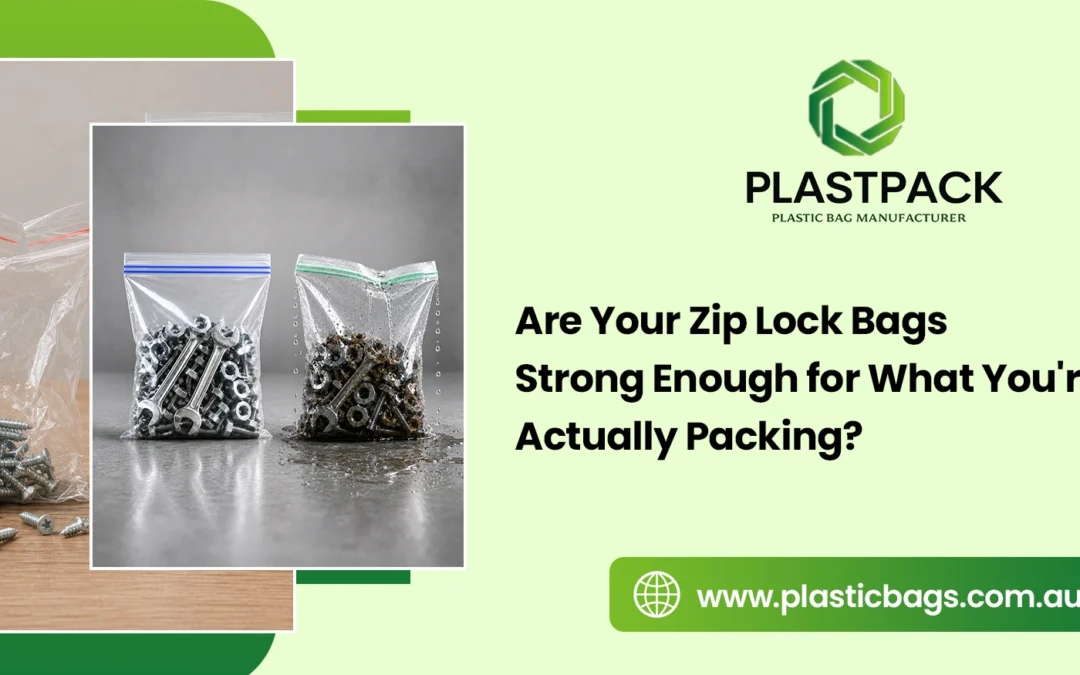
If your zip lock bags split, pop open in transit, or leave staff reaching for a second bag, they are not matched to what you are packing. The strength of a resealable bag is not a single number. It is the film gauge, the material, the seal and the size all working together against the weight, edges and handling of the contents. A bag that is fine for a handful of screws can fail under a heavier or sharper load, and one that works on the bench can let go once it is stacked in a carton for transport. This guide helps you tell whether your current bag is under-specified, and how to fix it without paying for strength you do not need.
What strong enough actually mean for a resealable bag
Four things decide whether a press seal bag holds. The first is the gauge, the thickness of the wall, measured in microns. The second is the material, since a soft, flexible LDPE film behaves differently from a stiffer, tougher blend at the same thickness. The third is the seal itself, the interlocking closure that has to keep gripping through however many times the bag is opened and closed. The fourth is the size and fit, because an over-filled bag puts the wall and the seal under constant stress, no matter how thick the film is. A bag can be thick and still fail if the seal is wrong or the bag is packed past what it was made to hold.
The signs your ziplock bag is under-specified
The bag usually tells you before you work it out on paper. Splits along a seam or down a wall point to a gauge that is too light for the weight. A seal that pops open in transit or under load is either the wrong seal for the job or a bag that has been overfilled. Punctures from sharp or hard contents mean the wall cannot take the edge profile of what is inside. If staff routinely double-bag, or you are seeing leaks, contamination or damaged contents on arrival, the current bag is under-specified for the task. None of these is the bag being faulty. They are the bag being asked to do a job it was not specified for.
Gauge: 50 micron, 75 micron, and when to step up
The gauge is the first lever to pull. A 50 micron press seal bag suits light contents, general storage and short runs, with good clarity for identifying what is inside, and it sits at roughly the thickness of a common snap-lock sandwich bag. A 75 micron bag is the heavy-duty option for sharp, heavy, abrasive or frequently handled contents such as fasteners, components, hardware and mechanical fittings. The thicker wall resists puncture and holds its seal through handling and transport. Match the gauge to the weight and the edge profile of the contents rather than defaulting to the lightest bag on the shelf. One honest caveat: a hard edge like glass or metal can eventually puncture polythene at any gauge with enough force, so pair the right thickness with the right size and sensible handling. The full range and the two core gauges are on the press seal bag page, and the thickness guide puts common micron figures in context.
The seal and the size do half the work
Gauge gets the attention, but the seal and the fit carry as much of the load. A pack that is opened and resealed many times needs a closure that keeps its grip through those cycles, not just on the first close. If a resealable bag stops holding after a few uses, the seal was the weak point, not the wall. Size matters just as much. Over-filling forces the contents against the seal and stretches the walls, which is a common reason a bag that looks strong enough still fails. Sizing is expressed as Opening by Depth, with the depth measured from the seal, so choose a size that holds the contents comfortably with a clean lip to close on. The right size in the right gauge reseals cleanly and lasts the distance.
Match the bag to the contents
Different jobs call for different specifications. For food portioning, dry goods and produce, use a food-grade press seal bag at a gauge that suits the weight, with the clarity to identify contents at a glance. For fasteners, hardware and workshop components, step up to 75 micron so the wall takes the sharp edges and the repeated bench handling. For samples and retail display, clarity and a firm seal matter most, with a write-on panel or printing where labelling helps. For pharmaceutical or clinical use, the bag should be specified against the relevant standards and handled through qualified procedures, and Plastpack manufactures to those requirements when the application is stated. Food-contact products are made to the relevant food safety standards, and more on that sits in the food packaging range.
Getting the right bag without over-specifying
Under-specifying costs you in damage, leaks, double bagging and returns, which wipes out any savings from a lighter bag. Over-specifying has a cost, too, since you pay for film you do not need on every unit across a high-volume run. The right answer is the gauge, material, seal and size that hold with a little margin to spare and nothing more. Because Plastpack extrudes its own film and forms the bags in its Australian facility, you can order zip lock bags to the exact gauge and size for the job, food-grade where needed, with a write-on panel or up to six-colour printing. The team can recommend a gauge based on your product weight, edge profile and handling conditions, and a sample can be produced so you can test the bag before a full run. Plastpack holds roughly 50 tonnes of film on site for quick supply, and the minimum for a custom size press seal bag is 10,000. For sizing, film type and seal decisions on a volume order, the wholesale buying guide works through the specification.
The quickest way to settle the question is to test it. Pack a sample the way your operation actually does, seal it, and put it through the same handling, stacking and transport it will face in service. If the seal holds and the wall shows no stress, you have your specification. To get a gauge checked and a sample sorted, send your product details, sizes and quantities through to Plastpack.
Frequently Asked Questions
How do I know if my ziplock bags are strong enough?
Watch for splits, seals popping open, punctures or staff double-bagging. Any of these means the gauge, seal or size is not matched to the contents. Pack a sample and put it through real handling and transport to confirm before ordering.
What is the difference between 50 micron and 75 micron press seal bags?
50 micron suits light contents, general storage and short runs with good clarity. 75 micron is the heavy-duty option for sharp, heavy or frequently handled items like hardware and components, resisting puncture and holding its seal through transport.
Why does my resealable bag seal keep popping open?
Usually, the bag is overfilled, which forces the contents against the closure, or the seal is not right for how often the pack is opened and closed. Choose a size that holds the contents with a clean lip and a seal rated for repeated use.
Are zip lock bags food safe?
Food-grade press seal bags made to the relevant food safety standards are suitable for direct food contact. State the food use when you enquire so the correct product is supplied for portioning, dry goods or produce.
Can I get a custom size or a printed press seal bag?
Yes. As the manufacturer, Plastpack produces press seal bags to your required size, gauge and seal, with write-on panels and up to six-colour printing available. The minimum for a custom size is 10,000, and a sample can be made before a run.