
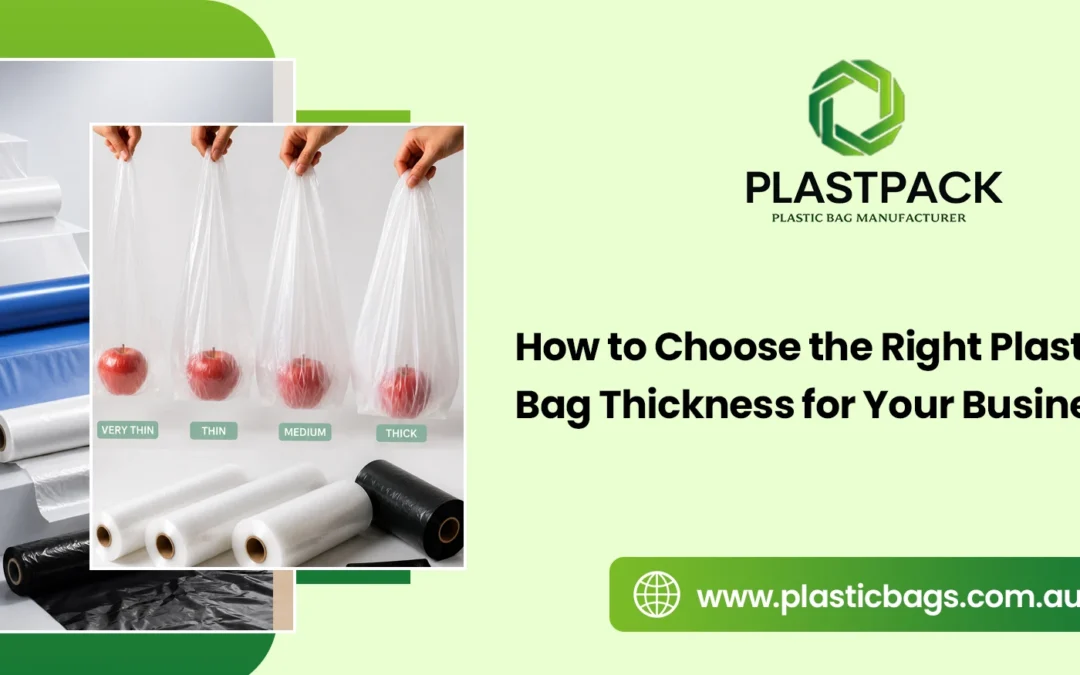
The right plastic bag thickness is the lightest gauge that still protects the product through its whole journey, from the packing bench to the end user. Go too thin and bags split, seals fail and goods arrive damaged. Go too thick and you pay for film and freight weight you never needed. Thickness is measured in microns, and choosing well comes down to four things: what you are packing, how it is handled, how far it travels and how it is stored. This guide walks a commercial buyer through those decisions so the gauge on your next order matches the job rather than a guess.
What plastic bag thickness actually means
In Australia, film thickness is measured in microns, written as um. A micron is one thousandth of a millimetre. Some imported stock still lists thickness in gauge, and a few suppliers use mil, which is one thousandth of an inch. The rough conversions are useful to keep on hand: about 4 gauge equals 1 micron, so 100 gauge is roughly 25 microns, and 1 mil is about 25 microns. The practical point is to confirm which unit a quote uses before you compare two bags, because a number that looks similar can describe very different films. For the micron ranges tied to common bag types, the plastic bag thickness guide sets them out in full.
Thickness is not the whole strength story
Two bags at the same micron rating can perform differently depending on the film they are made from. LDPE is soft and flexible and suits general packing and food-safe containment. HDPE is stiffer and carries weight well for its gauge. LLDPE is valued for puncture resistance under stress, which is why it turns up in pallet liners and courier films. Specify material and thickness together, not thickness on its own. One more detail catches buyers out. Films produced to nominal gauge can run up to around ten per cent thinner than the stated figure, which is normal manufacturing tolerance. If your application depends on an exact wall thickness, ask for the bags to be made to full gauge so the specification is held precisely.
The questions that decide the right gauge
Five questions cover almost every case. First, what are you packing? Weight, size, and any sharp or hard edges set the baseline. A soft garment and a boxed metal fitting are not the same job. Second, how is the bag handled and sealed? A bag that is heat sealed on a line, loaded heavily, or opened and closed repeatedly needs more wall than one that is filled once and set down gently.
Third, how far does the product travel? A bag handled by your own team for a local drop faces less stress than a parcel moving across the country through a third-party carrier, where drops, stacking and weather all add up. Longer journeys call for more protection. Fourth, how is the stock stored before use? Film held in a hot or sunlit area weakens over time, so a business with exposed storage benefits from a heavier gauge and, more importantly, from keeping stock cool, dry and in its cartons, as covered in the transparent packaging guide. Fifth, is the content food or a regulated item? Food-contact bags must be made to food-grade material standards, and carry bags carry a compliance dimension covered further down.
Matching thickness to the job
Once those questions are answered, the application points to a sensible range. Light retail wrapping, garment bags and mailers for soft goods sit at the lower end of the scale. General packing, carton lining and food portioning move up into the middle. Heavy, sharp or industrial contents, pallet covers and waste applications need the heavier gauges to hold up under load and handling. Resealable packs follow the same logic. A press seal bag in 50um suits lighter contents and short storage runs, while 75um is the choice for heavier, sharper or frequently handled items where a lighter wall would split at the seal. For the everyday workhorse formats, the plain poly bag range covers small, medium and large with the sizing and gauge listed on each product.
The compliance angle for carry and checkout bags
For carry and checkout bags, thickness is not only about durability. Lightweight single-use plastic shopping bags are restricted across Australian states, and heavier reusable carry bags sit above those lightweight thresholds. The exact requirement varies by state and has changed over time, so confirm the current rule for the states you trade in before committing to carry bag stock. A retailer choosing a carry bag is selecting a gauge that is fit for repeated use and compliant with where it is handed out, which is a different decision to picking a plain poly bag for the back of house.
The cost of getting the thickness wrong
Under-specifying is the expensive mistake dressed up as a saving. A gauge that is too light tears on the line, splits under load or fails at the seal, and the cost lands as damaged goods, returns, rework and lost time, which dwarfs the few cents saved per bag. Over-specifying has a quieter cost. You pay for resin you do not need and add weight to every parcel, which shows up in freight across a high-volume run. There is also a waste trade-off, since two thin bags used to do the work of one correct bag create more plastic and more handling, not less. The target is the right gauge for the job, not the thinnest available and not the thickest.
How made-to-specification thickness help
Because Plastpack extrudes its own film and forms bags at its Australian facility, gauge is not limited to a fixed catalogue item. Bags can be made to the exact micron the job needs, in the right film type, and to full gauge where precision matters. Plastpack holds roughly 50 tonnes of film stock on site, so the material for most standard and many custom orders is already available for quick supply. If you are unsure which gauge suits your product, the team can recommend a thickness based on product weight, edge profile and handling conditions, and a sample can be produced so you can test the film under a real load before a full run. For film type, sizing and seal decisions on a volume order, the wholesale buying guide works through the specification step by step, and the full plastic bags range shows the base products to start from.
The reliable way to settle a thickness question is to test it. Order a sample in the gauge you are considering, pack it the way your operation actually will, and put it under the load and handling it will face. If it holds cleanly with a little margin to spare, you have your specification. To get a gauge checked and a sample sorted, send your product details and quantities through to Plastpack.
Frequently Asked Questions
How is plastic bag thickness measured in Australia?
Thickness is measured in microns (um), one thousandth of a millimetre. Some imported stock uses gauge or mil instead. As a rough guide, 4 gauge is about 1 micron and 1 mil is about 25 microns, so always confirm the unit before comparing quotes.
What thickness plastic bag do I need?
It depends on the weight and edges of the contents, how the bag is handled and sealed, and how far it travels. Light retail items suit lighter gauges, while heavy, sharp or industrial goods need heavier ones. The micron guide lists ranges by bag type.
Does a thicker bag always mean a stronger bag?
Not on its own. Two bags at the same micron rating can perform differently depending on the film blend, whether LDPE, HDPE or LLDPE. Specify the material and the thickness together rather than judging strength by gauge alone.
What thickness do I need for a compliant carry bag?
Reusable carry bags are specified at heavier gauges that sit above the lightweight single-use thresholds. The exact requirement varies by state and has changed over time, so confirm the current rule for where you trade before ordering.
Can I order a custom plastic bag thickness?
Yes. Because the film is made in-house, bags can be produced to the exact micron your job needs, in the right film type, and to full gauge where precision matters. A sample can be made so you can test the gauge before a full run.